ARTICLE · TODD KELSEY
Global AI Agency: MANGO-X Meets D-BAM
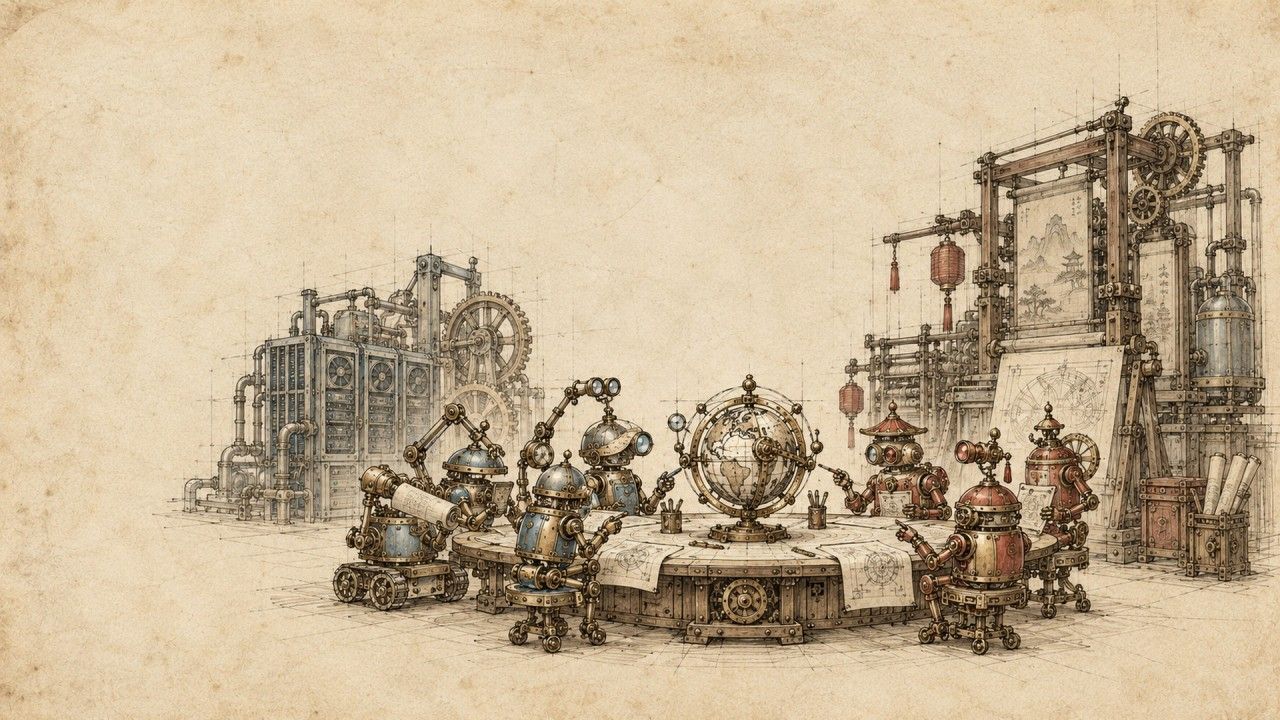
A fictional roundtable between American and Chinese frontier AI labs
MANGO-X: Microsoft, Anthropic, NVIDIA, Google, OpenAI and xAI. Their agent roster is Copilot, Claude, Gemini, ChatGPT and Grok.
D-BAM: DeepSeek, ByteDance, Alibaba and Moonshot AI. Their agent roster is DeepSeek, Doubao, Qwen, Kimi and MiniMax.
Two groups walk into a room
MANGO-X arrives as a vertically layered system.
- Microsoft owns an installed enterprise estate and a distribution surface measured in organizations rather than model downloads.
- Anthropic concentrates on reliable, deep work across research, writing and code.
- NVIDIA supplies the machines, software and economics beneath nearly everyone else's ambition.
- Google combines frontier research, cloud infrastructure, distribution and one of the world's largest knowledge systems.
- OpenAI pushes toward a general-purpose human workbench that can reason, use tools and complete work across applications.
- xAI brings real-time public conversation, rapid infrastructure expansion and an appetite for persistent agents.
D-BAM arrives differently.
- DeepSeek turned efficiency and open deployment into strategic prestige.
- ByteDance can move models into consumer products and media systems at extraordinary speed through Doubao and its broader ecosystem.
- Alibaba's Qwen family joins open models to cloud distribution and a huge developer surface.
- Moonshot's Kimi has made long context, research and agentic knowledge work central to its identity.
- MiniMax has multimodal strength: text, voice, image and video are converging into one creative and operational layer.
Tencent, Zhipu AI and other Chinese teams exemplify research, distribution, open-model usage, capital, enterprise adoption or consumer reach. China now has a dense competitive sector.
The first question
To MANGO-X: How much of the economy can your agents enter, understand and operate?
To D-BAM: How much intelligence can you make cheap, adaptable, distributable and unavoidable?
An American advantage is still in frontier compute, capital, cloud control planes, enterprise relationships and premium integrated products.
A Chinese advantage is increasingly visible in efficiency pressure, open-model availability, ruthless product iteration and the ability to join models to enormous domestic platforms.
MANGO-X discovers that NVIDIA is not merely a supplier
At the American end of the table, the Fab Five speak in product names: Copilot, Claude, Gemini, ChatGPT and Grok. NVIDIA says little. Its machines hum underneath the room.
NVIDIA is the industrial substrate that helps determine the price, speed and geographic location of frontier intelligence. Microsoft and Google add cloud capacity. OpenAI, Anthropic and xAI turn compute into behavior.
This creates strength and fragility at the same time. The American stack can deliver tightly integrated, high-capability systems, yet it is capital intensive and concentrated. Export controls, power availability, chip supply, data-center construction and cloud bargaining power become part of model strategy.
D-BAM discovers that open models are distribution
Open-weight distribution changes the economics of agent adoption.
An enterprise, developer or country that cannot justify a premium closed model for every step of a long agentic workflow can route more work through efficient open models. Agent systems consume many tokens while planning, calling tools, checking results and trying again. In that world, a model that is slightly less capable but dramatically cheaper—or deployable under local control—may win far more work than a leaderboard suggests.
This is one reason why Qwen, Kimi, DeepSeek and MiniMax matter beyond China. They are not only national champions. They are components that can be inserted into global agent stacks.
ByteDance adds a different form of power: the ability to connect intelligence to distribution, content and daily behavior at consumer scale.
Mixing, Remixing
A U.S. company may run a Claude or OpenAI model for high-stakes reasoning, a Qwen or DeepSeek model for lower-cost subtasks, NVIDIA hardware underneath, Microsoft identity controls around the workflow and Google's data or search services feeding it. A Chinese developer may use open protocols and techniques created in the United States while optimizing for domestic chips and local platforms.
The Model Context Protocol captures part of this shift. When tools and data sources can expose a common interface, models become more substitutable and orchestration becomes more valuable. The durable advantage moves upward into memory, permissions, workflow design, evaluation and the ability to prove what an agent saw and did.
That is where my own research has been looking. The more interchangeable the models become, the less sensible it is to let any one provider exclusively own an organization's working memory. The missing layer is portable continuity with provenance: not merely what an agent remembers, but which evidence it used, what authority it had and what state of the world existed when it acted.
Negotiation
No one at this table is going to agree on a universal theory of safety, speech or data governance. A useful meeting would begin lower, with operational agreements that remain valuable even under rivalry.
- Incident vocabulary. Shared categories for agent failures involving unauthorized action, deceptive behavior, data leakage and loss of control.
- Evaluation transparency. Clearer disclosure of what benchmarks measure, how tool use is scored and where results depend on hidden scaffolding.
- Traceable action. Interoperable records of tool calls, source evidence, permissions and consequential changes.
- Identity and delegation. Ways to distinguish a person, the agent acting for that person and a swarm of subagents operating under bounded authority.
- Energy and compute accounting. Comparable reporting for the resource cost of training and long-running agent work.
- Human escalation. A common expectation that high-impact actions reach a responsible human with enough context to make a real decision.
This is plumbing for a world in which American, Chinese and other systems will interoperate and appear together inside third-party products, whether governments welcome the mixture or not.
Inquiring Minds Want to Know
Who will establish the defaults for agentic work?
Who owns the identity layer? Who controls the tools? Where does memory live?
Which model handles the expensive judgment step and which models perform the thousands of cheaper actions around it?
Who can inspect the evidence later?
Can a person or institution move its accumulated context to another system without beginning again?
MANGO-X begins with compute, enterprise access, frontier capability and integrated products.
D-BAM begins with efficiency, open distribution, platform scale and intense internal competition.
MiniMax reminds everyone that the interface is already expanding beyond text.
The next phase of AI will be decided by the systems that make intelligence useful, affordable, governable and persistent.
Further Reading
- Model Context Protocol, Introduction — open protocol connecting AI applications to tools and data sources.
- Stanford Digital Economy Lab, The Enterprise AI Playbook (2026) — production adoption, model routing and the growing role of Chinese open models in agentic workloads.
- Official product and developer materials: OpenAI, Microsoft Copilot, Anthropic, Google AI, NVIDIA AI, xAI, DeepSeek, ByteDance Seed, Qwen, Moonshot AI and MiniMax.
Todd Kelsey · Tsunami Labs · September 2026