ARTICLE · TODD KELSEY
AI Agent Wars II — The One-Person Company Gets a Workbench
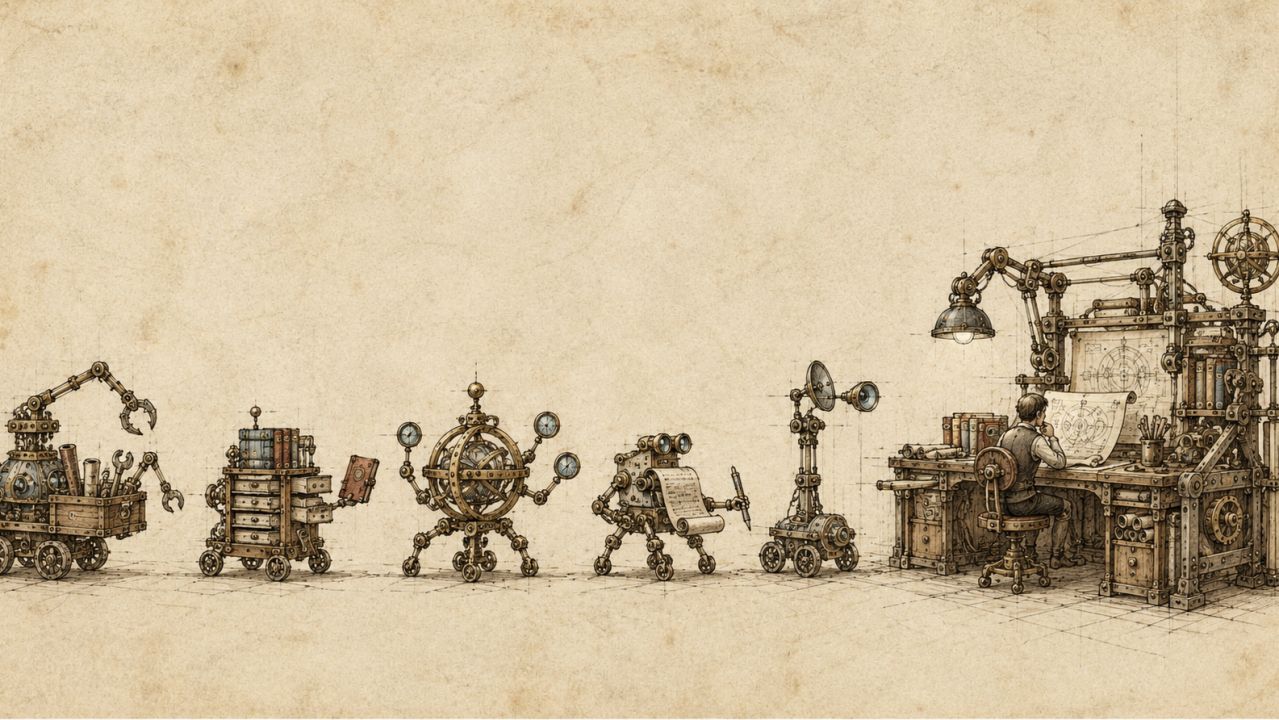
The one-person company gets a workbench
Todd Kelsey · Tsunami Labs
This is why developers and “one-person startup” founders have been going insane.
The world is moving fast—not because one model crossed a magical line, but because several agent stacks can now perform enough of the work surrounding an idea to change who can attempt it. Research, product definition, coding, design, browser action, outreach, analysis and finished deliverables are starting to converge.
The newest shift is ChatGPT Work. Its utility is not simply that it can do more tasks. It increasingly holds the tasks together: context, connected apps, files, browser work, coding and finished artifacts can live inside one human-facing operating environment.
The comparison I sent to a Colleague
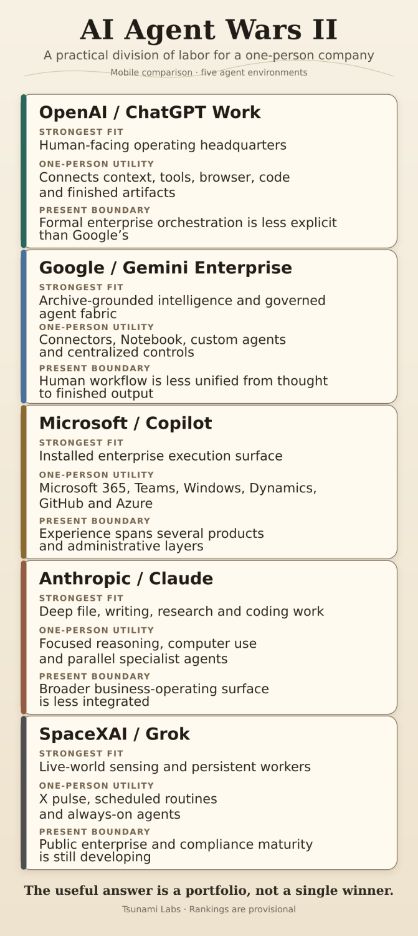
I recently sent two corporate colleagues a practical comparison of the five major agent environments. The question was not “which model wins?” It was: where does each stack create the most leverage, and how should a small organization divide the work?
The short version remains useful:
What changed with ChatGPT Work
The earlier generation of agents often felt like brilliant contractors with amnesia: impressive inside a bounded task, but dependent on the human to carry context, move files, reopen tools and assemble the result.
ChatGPT Work adds a different dimension. OpenAI describes it as gathering context, planning an approach, taking action across tools, files and desktop apps, and creating finished documents, spreadsheets and presentations. In use, the important part is the continuity between those stages.
The workflow behind this article is a small example. Work located the exact email I sent a colleague, recovered the original comparison, checked the current product pages, created the illustration and assembled a native article draft. That is not a benchmark. It is a useful proof of integration.
Why developers and one-person founders are reacting so strongly
The startling change is role compression. One person can now coordinate work that previously required separate passes by a researcher, product manager, developer, designer, analyst, operations lead and editor.
That does not make those disciplines trivial. It reduces the cost of crossing the boundaries between them. The marginal cost of testing an idea has collapsed, and the coordination cost is beginning to fall with it.
For a one-person company, the practical requirements are straightforward:
The system must preserve enough project context that the founder does not restart from zero.
It must reach the real tools and information where work already lives.
It must move from analysis into action without hiding consequential choices.
It must produce usable artifacts—not merely advice about producing them.
It must support specialist models and agents without trapping organizational memory inside one vendor.
It must preserve provenance, permissions and the state of evidence used for important decisions.
No single winner: use a portfolio
My working division remains:
Use ChatGPT Work as the human-facing operating headquarters and general-purpose conductor.
Use Google for archive-grounded intelligence and durable, governed enterprise-agent orchestration.
Use Microsoft where work must execute inside the installed enterprise estate.
Use Claude for intensive file, research and coding work.
Use Grok for live-world sensing and experiments with persistent digital workers.
The strongest systems are converging, so any ranking is only temporary. Their shapes still matter. Google and Microsoft lead from the enterprise control plane. Claude leads from deep focused work. Grok pushes the persistent-worker model. ChatGPT Work currently offers the clearest general-purpose workbench for a person trying to carry an entire project from thought to finished output.
The missing layer is durable, model-independent continuity. Permissions and audit can establish who was allowed to act; a system such as Memory Atlas should preserve the exact evidentiary state an agent used so the decision can later be reconstructed. No platform should exclusively own an organization’s memory.
The utility is already here
The sober conclusion is more consequential than the hype: these systems do not need to replace founders, developers or institutions to change the economics of building. They only need to let smaller teams complete more of the surrounding work, with less handoff loss, while keeping human judgment at the center.
The world is moving fast. The durable advantage will not come from sampling every launch. It will come from building repeatable workflows, preserving evidence and knowing where human attention matters most.
Sources
OpenAI — ChatGPT Work Google Cloud — Gemini Enterprise Microsoft — Copilot Studio Anthropic — Claude Code SpaceXAI — Grok