ARTICLE · TODD KELSEY
Artificial Intelligence Impact on Business Jobs

This simple analysis discusses the likely impact of automation and AI (artificial intelligence) on job market in four sample business areas: Accounting/Finance, Marketing/Analytics, Entrepreneurship and Human Resources. The article also highlights an excellent, highly relevant “job automation calculator” from the BBC, which can be thought provoking for individuals in the classroom and the boardroom.
In general, since the beginning of the calendar year 2017, I’ve been paying increasingly careful attention to emerging data and studies about the projected impact of artificial intelligence and automation on the job market. Generally speaking, what the data says to me is not “if”, but “when” there will be significant impact on the job market. Some industry sources point to past trending as other technologies have provided disruption but then led to new jobs, but no one knows for sure.
And in this era, there is evidence that a much larger number of jobs can be replaced by automation and AI (artificial intelligence), at a pace that could be much quicker than past disruptions, due to the rapidly increasing power and ubiquity of cloud-based applications and tools. More and more work is being done online, which makes it much easier to automate.
One of my goals has been to look for convincing evidence to the contrary, evidence to suggest that a significant amount of new jobs are likely to be created to fill the gap, and so far, I haven’t seen anything convincing beyond speculation. And some of it comes down to language – terms such as the “disaggregation of work” and a “task-based economy” are increasingly popular, where a “gig economy” gives rise to more temporary task based work that treats people as resources that can allow a company to rapidly scale up and down with demand, at less cost. Along these lines, at some point this year a claim was made that “90% of jobs are not fully automatable” – which sounds great, except what about the portions that can be automated, and the overall resultant reduction in labor.
(Note: for educators and students, it is possible to get Wall Street Journal and NY Times access at significant discounts; otherwise I’d say that I do believe reading any of these articles is worth investing in.)
1) Accounting/Finance
Short/medium term outlook: ok | Medium-Long-term: down
Pro: Employment of accountants and auditors is projected to grow 11 percent from 2014 to 2024, faster than the average for all occupations. In general, employment growth of accountants and auditors is expected to be closely tied to the health of the overall economy.
https://www.bls.gov/ooh/business-and-financial/accountants-and-auditors.htm
But: the bureau of labor stats is basing this on economic growth and is not taking automation into account. There is a human dimension but many processes are already starting to be automated, and companies are announcing the adoption of automation platforms in finance.
Ex: (circa October 2017): "Global firms develop software to liberate workers from time-consuming, repetitive tasks—and reduce finance-department employee numbers"
https://www.wsj.com/articles/companies-leave-bean-counting-to-the-robots-1508407203
There is a human element, yet increasing amounts of business process is automated, creating overall less work, which will lead to less overall jobs.
No one can say how soon but there is clear evidence of “automatability”:
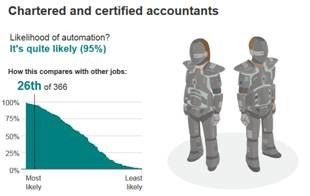
(Source - job automation calculator - http://www.bbc.com/news/technology-34066941)
I strongly invite you to try the job automation calculator out, for yourself, and in the classroom – it’s a great tool for visualizing some of the related issues.
2) Business Analytics/Marketing
Short-Medium term outlook: excellent | Medium-Long-term: excellent
Business analytics is a strong growing area year over year, part of the “big data” revolution, involving data-science and the growth of artificial intelligence. For example, these are 3 of the 5 most in demand skills for Data Analysis jobs:
- Data Analysis: the critical-thinking ability to interpret numbers. In addition to knowing how to use specific programming languages and tools, employers need you to discern when patterns in data are meaningful, so that you can draw accurate and actionable conclusions.
- SQL: SQL, the second-most in-demand skill, is a programming language used to retrieve information from a database.If you want to be a business analyst, data analyst, data engineer, data scientist, web developer, software engineer or database administrator, it’s important to know SQL.
- Business Intelligence: business intelligence is the practice of gathering data to inform business decisions. For example, company using direct mail and Facebook ads to market its products can use business intelligence software to help understand how well each marketing tactic is working. Business analyst, business intelligence developer and customer insight analyst are a few jobs requiring business intelligence skills.
For example, in LinkedIn’s list of top skills to get people hired for 2017, among the very top ten include Statistical Analysis and Data Mining, and Data Presentation.
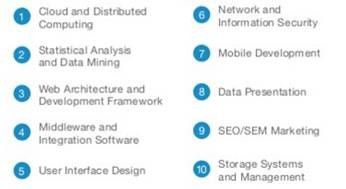
Similarly, in the above list, SEO/SEM Marketing are core digital marketing fields, and the year over year demand for digital marketing has been high in comparison to any other field. (SEO = search engine optimization, SEM = search engine marketing, basically two sides of a coin that drives Google’s core business).
Depending on how analytics and marketing is defined and deployed, resulting jobs are exposed to automation to varying levels, but overall the area is on the cutting edge, inasmuch as it is connected to data science. The more technical understanding a person has of emerging trends, tools, and how analytics is used, the better off they will be 5, 10, 15, 20 years down the road. Here are some more related snapshots from the job automation calculator:
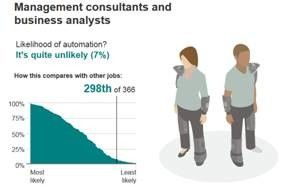
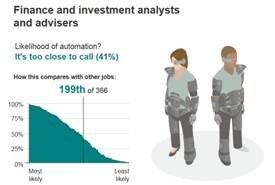
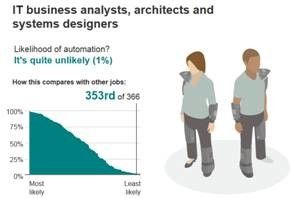
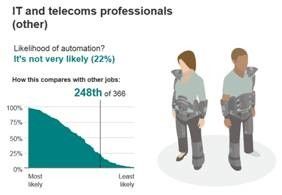
Try it! BBC Job Automation Calculator: http://www.bbc.com/news/technology-34066941
3) Entrepreneurship
By definition entrepreneurs help to create jobs, and the opportunities and prospects are very strong.
As the nation strives to recover from the “Great Recession,” job creation remains one of the biggest challenges to renewed prosperity. Small businesses have been among the most powerful generators of new jobs historically, suggesting the value of a stronger focus on supporting small businesses—especially high-growth firms—and encouraging entrepreneurship.
And there is absolutely strong demand in the younger generation for this:
A survey from Bentley University suggests that millennials sense that career success will require them to be more nimble, independent and entrepreneurial than past generations. Only 13% of survey respondents said their career goal involves climbing the corporate ladder to become a CEO or president. By contrast, almost two-thirds (67%) of said their goal involves starting their own business.
As a society, we should do everything we possibly can to empower every young person to learn about entrepreneurship, including opportunities to take classes, participate in workshops and get support from business mentors.
4) Human Resources/Management
Short-Medium term outlook: ok | Medium-Long-term: ok
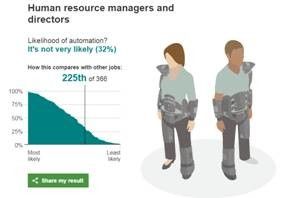
In some respects, the availability of human resources jobs is probably tied closely to overall economic forces, and to whatever extent a given job involves ongoing human contact, it may not be particularly automatable, but there are also aspects of HR-related work that can be highly automated. (i.e., any repetitive work).
Conclusion
In both the short and long term, there will be consistent demand for the more technical end of business, especially Business Analytics and Digital Marketing. In order to attempt to help prepare society for the disruption that will be caused by automation and artificial intelligence, I believe it’s important to explore, discuss and debate these issues.
I invite you to consider responding, especially if you know of any significant evidence to suggest that there will not be massive job disruption, or even evidence that points to the possibility of “job replacement” with new types of jobs. In most of the reading I’ve done, while looking for opposing viewpoints and alternative data, I haven’t seen much.
Also, if you’re interested, I’m starting to write a book on a related topic, to suggest ways for individuals to respond, and if you’d like to review it as it is being written, please connect with me on LinkedIn and request to be put on the list. I’m also particularly interested in interviewing anyone who is actively involved in artificial intelligence research, product development, as well as anyone who has looked at where things are heading and is actively pursuing learning more about it. Basically I want to encourage people to learn as much as they can.
Additional References
Will automation steal jobs? Price Waterhouse Coopers, March 2017
https://www.pwc.co.uk/economic-services/ukeo/pwcukeo-section-4-automation-march-2017-v2.pdf
BBC Job Automation Calculator: http://www.bbc.com/news/technology-34066941