ARTICLE · TODD KELSEY
ChatGPT vs. Gemini: The Race Is No Longer Just About the Model

Todd Kelsey · Tsunami Labs · September 24, 2026
For ordinary users, comparing ChatGPT and Gemini used to sound simple: which chatbot gives the better answer?
That is no longer the most useful question.
The platforms are becoming working environments. They remember projects, reach into applications, create persistent artifacts, and increasingly carry a task from research to a finished result. The race now has several events: intelligence, memory, autonomy, applications, artifacts, and price.
My shortest current distinction is this:
ChatGPT increasingly makes the AI conversation, its accumulated context, and its actions part of the durable workspace. Gemini increasingly makes your Google information environment the durable workspace and brings AI into it.
Neither description is permanent. Both companies are rapidly invading the other’s territory. It is still a useful way to understand what each platform feels like today.
The comparison at a glance
Long-running project workspace
ChatGPT: Projects combine chats, files, instructions, and project history; project-only memory can isolate the workspace.
Gemini: Gems, Drive projects, saved conversations, and selected Workspace sources create focused contexts around Google information.
Cross-chat continuity
ChatGPT: Particularly strong when decisions, conversations, accumulated instructions, and prior agent work are part of the asset.
Gemini: Particularly strong when authoritative state already lives in Drive, Docs, Sheets, Gmail, and other Google services.
Workspace files
ChatGPT: Connected files, Library, generated artifacts, and—in supported cases—direct updates to source applications.
Gemini: The deepest native connection to Docs, Sheets, Slides, Gmail, Meet, and Drive because those applications are the host environment.
App reach and autonomy
ChatGPT: Work combines research, connected apps, browser/computer interaction, local files and desktop apps, schedules/triggers, and finished deliverables.
Gemini: Connected Apps now include Google and third-party services, creative tools, and custom MCP apps; capabilities remain specific to each connection, account, device, and supported action.
Sites and interactive artifacts
ChatGPT: ChatGPT Sites can generate, preview, refine, host, and publish working sites from Work or Codex on eligible paid plans.
Gemini: Gemini can create dynamic artifacts and can generate Wix site layouts through a Connected App; Wix editing and publishing still hand back to Wix.
Best fit
ChatGPT: Projects in which conversation history, evolving decisions, files, tools, and execution together constitute the workspace.
Gemini: Workflows in which Google Workspace is already the system of record and the AI should work through it.
1. The AI that can leave the chat
This is the first distinction worth lifting out of the chart.
ChatGPT Work is designed for delegation: research the problem, inspect files, use connected applications or a browser, work with local folders and desktop applications where permitted, create the deliverable, and return with something that can be reviewed. OpenAI describes Work as the mode for longer, multi-step work and finished deliverables rather than everyday conversation.
Imagine asking:
Make a small playable game, put it into a browser-based development environment, test the main interactions, fix what breaks, and leave me with a working build.
In a Replit-style workflow, the important capability is not merely generating code. It is crossing the boundaries among the brief, files, browser-based editor, preview, test results, revisions, and the finished artifact.
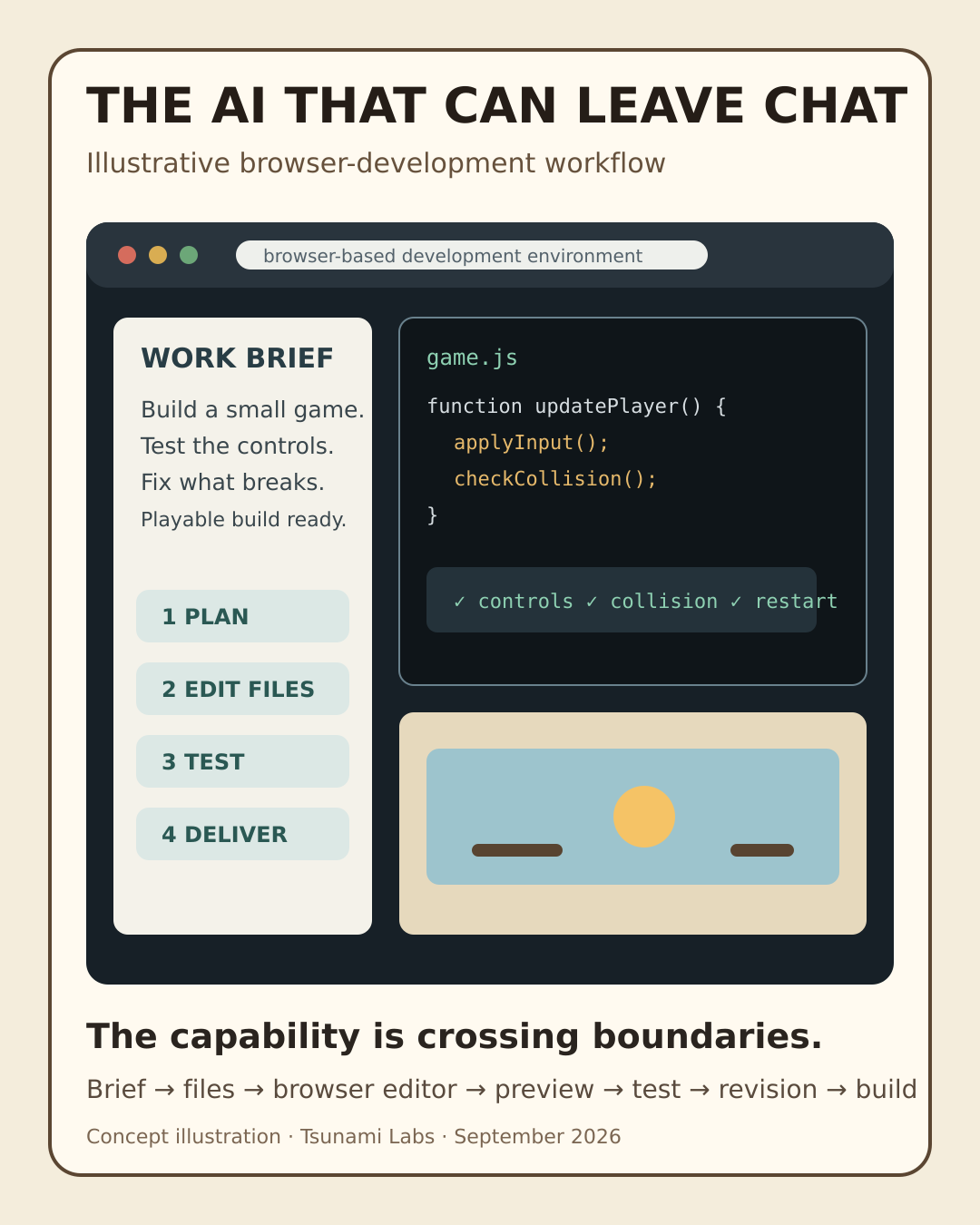
Figure 1. Illustrative workflow, not a claim of a dedicated Replit connector. ChatGPT Work can use a cloud browser on supported sites; exact sign-in, editing, and deployment actions depend on the site, permissions, and current account access.
Now consider a more demanding creative pipeline:
Build a simple Unreal Engine scene, organize the project files, generate supporting assets and code, test the interaction, and document what still needs human review.
The current ChatGPT desktop architecture makes this direction plausible because Work can use local files and desktop apps with permission, while Codex can work with local folders, repositories, terminals, and developer tools. That does not mean every Unreal control is automatically supported. It means the product boundary is moving from “tell me how” toward “work across the environment with me.”
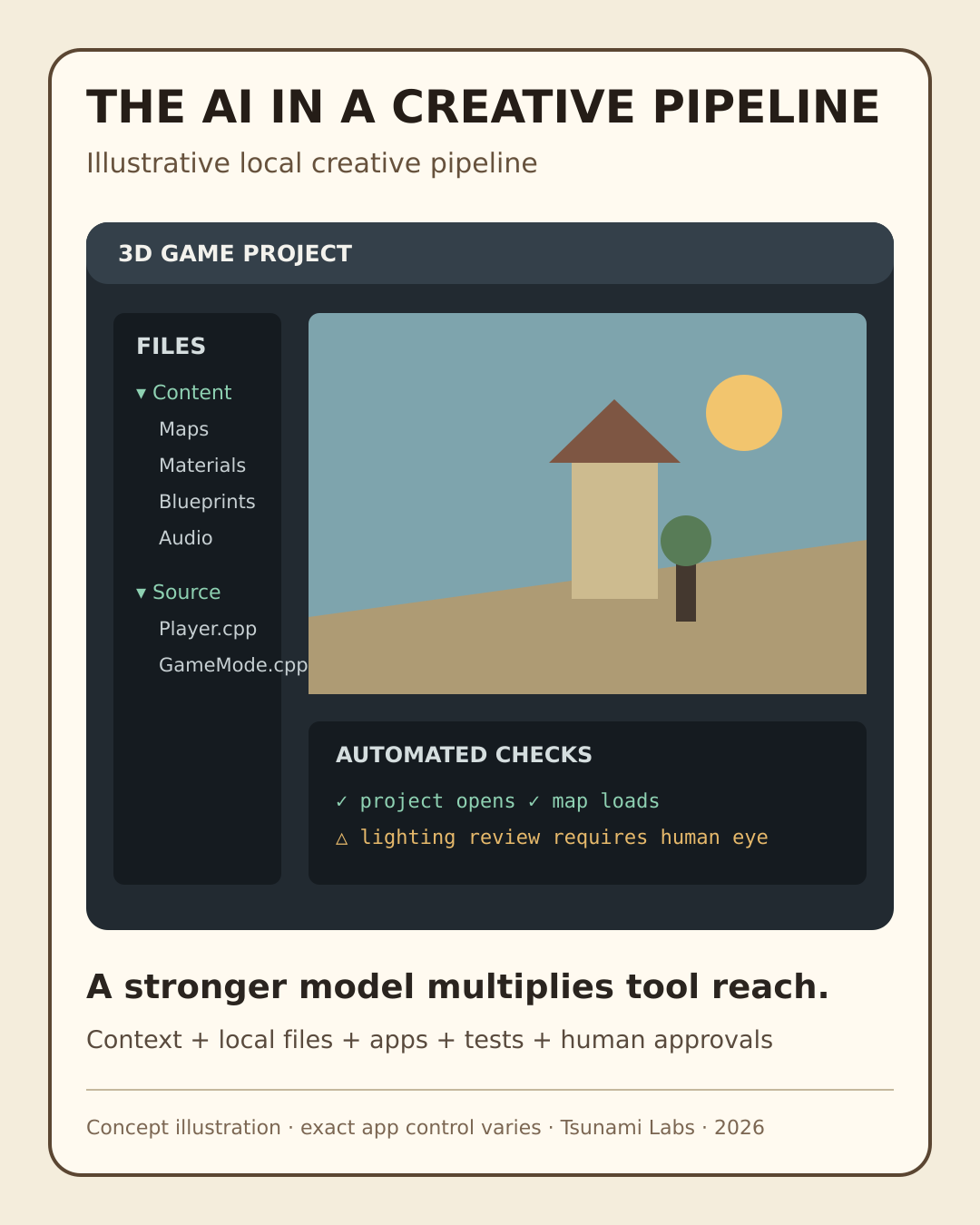
Figure 2. Illustrative local creative pipeline. Actual Unreal Editor control depends on operating-system permissions, supported computer-use behavior, project configuration, and the need for human approvals.
Can Gemini do the same thing?
Parts of it, yes—and the answer changed materially in 2026.
Gemini now has Connected Apps for Google and third-party services, plus custom apps connected through Model Context Protocol servers. Google documents native creative connections including Canva and Wix. Gemini can ask Wix to build layouts, pages, forms, galleries, and booking widgets; it currently cannot edit or publish the finished Wix site for you and instead links you back to Wix for those steps.
As of September 24, I could not find a documented first-party Gemini connection for Replit or Unreal Engine. A custom MCP integration can make new workflows possible, and Gemini can still generate code, plans, assets, and instructions. That is different from a documented, general-purpose mode combining browser action, local desktop access, files, schedules, applications, and deliverables.
So the fair conclusion is not “Gemini cannot use outside apps.” It clearly can. The present distinction is breadth and orchestration: ChatGPT Work exposes a more unified general-purpose execution surface, while Gemini’s external actions are more visibly bounded by the connected application and the specific actions Google and that application support.
2. Where does the durable work actually live?
This is the second distinction worth lifting out of the chart.
Suppose you spend three weeks developing a grant proposal, a research project, or a new business.
In ChatGPT, the durable asset may include the conversation history, project instructions, decisions, files, branch points, research, prior agent actions, and the deliverables produced from them. The AI-native workspace itself holds a meaningful part of the project’s state.
In Gemini, the durable asset may more naturally be the continuously changing Google environment: Docs, Sheets, Drive folders, Gmail threads, Slides, Meet records, and saved sources. Gemini can reason over and create within the system where many organizations already keep their authoritative work.
Here is the practical version:
- ChatGPT: “Continue the project we have been building, including what we decided and what the agent already did.”
- Gemini: “Continue from the current state of the files, mail, calendar, and records already inside Google Workspace.”
For a system such as Memory Atlas, the first architecture is unusually valuable when conversations, branches, provenance, superseded decisions, and the exact state of evidence matter. The second is extremely attractive when the system of record is already Workspace and AI should operate over it without continually exporting and re-uploading copies.
The platforms are converging. ChatGPT is pulling external applications and live files inward. Google is adding memory, projects, custom apps, persistent agents, and reusable context. The distinction is about their center of gravity, not an unchangeable limit.
Astra changes the race
GPT-6 Astra matters less as a new name on a leaderboard than as a model inserted into Work and Codex.
OpenAI makes GPT-6 Pro, powered by Astra, available in ChatGPT on the $100 and $200 Pro plans and selected business tiers. Plus includes limited Astra use in Work and Codex. OpenAI also says Astra can consume an account’s allowance faster than GPT-5.6 Sol, depending on task complexity, reasoning level, and input/output size.
That is the emerging economics of frontier AI in plain language:
A subscription no longer buys one fixed amount of “AI.” It buys access to a ladder of models and a finite amount of expensive reasoning and agent work.
The best model may be wasteful for routine cleanup and worth every credit for a difficult investigation, unfamiliar codebase, or consequential synthesis. Model repricing increasingly means that providers can make frontier intelligence available more broadly while charging—through allowances or credits—for how much of it a task actually consumes.
Astra also raises the competitive bar for the whole workbench. A stronger model is more valuable when it can inspect the environment, recover context, choose tools, execute steps, and produce the final artifact. Intelligence and integration multiply each other.
Price Wars — September 24, 2026 snapshot
Do not laminate this table. Models, limits, rollouts, credits, and prices are moving too quickly. Verify the current offer before buying.
ChatGPT for an individual
Free — $0
Enough to try mainstream ChatGPT, search, files, Projects, and supported plugins. It is not a dependable route to ChatGPT Work or Sites; official availability currently places Work on eligible paid plans and Sites on Plus, Pro, and workspaces.
Plus — $20/month
The practical entry tier for Work and Sites. Enough for an individual to build and publish a modest site, use connected apps and browser-based work, and sample Astra in Work/Codex within limited included usage.
Pro $100 — $100/month
Adds GPT-6 Pro in Chat and lets Astra use the plan’s full existing Work/Codex allowance. Sensible when multi-step delegated work is becoming a regular part of the week rather than an occasional experiment.
Pro $200 — $200/month
The heavier-use version for people repeatedly running complex research, coding, creation, and agent workflows. The value is capacity, not a wholly different concept of the product.
The clean rule for most curious users is: start free to understand the interface; move to Plus when you actually want Work or Sites; consider $100 only when the time saved by frequent delegation is visible.
Google Workspace business pricing
Google’s business pricing is compelling because it bundles AI with the office, storage, meeting, and email environment many people already need.
Business Starter — $7/user/month — $8.40/user/month
30 GB pooled storage and Gemini assistance in Gmail.
Business Standard — $14/user/month — $16.80/user/month
2 TB and Gemini across Gmail, Docs, Meet, and more—the most relevant comparison tier for a one-person professional.
Business Plus — $22/user/month — $26.40/user/month
5 TB plus stronger security, eDiscovery, and larger meetings.
Google may display introductory discounts; the standard prices above make the comparison clearer. Consumer Google AI subscriptions and enterprise add-ons are separate products, so they should not be mixed casually into the per-seat Workspace table.
The pricing comparison is not perfectly symmetrical. A $14 Workspace Standard seat includes business email and an office suite. ChatGPT Plus is more directly a subscription to the AI workbench. The right question is not only “which costs less?” It is “which environment already contains the work, and how much autonomous work will I actually delegate?”
Claude and Grok are still in the race
This should not become a five-company catalog, but leaving out Claude and Grok would give readers the wrong picture.
Claude remains exceptionally strong for deep writing, coding, research, and long-running focused work. Anthropic’s Cowork brings agentic capabilities to knowledge work, while its desktop product can reach local folders and applications. Independent evaluation in September placed Claude Opus 5.5 at or near the frontier, with particular strength in agentic knowledge work.
Grok is pushing a different edge. Grok Bot is presented as a team of always-on agents with their own computers that can work across tools and applications, and xAI continues to improve coding and real-time voice-agent capabilities rapidly.
That is consistent with my earlier AI Agent Wars II — The One-Person Company Gets a Workbench: the useful answer is often a portfolio, not a permanent winner. Leadership can change before an article describing the previous leader is old.
Is there a Consumer Reports for AI models?
The closest current answer is Artificial Analysis.
Its LLM Leaderboard compares more than 250 models across intelligence, price, output speed, latency, context window, and other measures. It also publishes readable model-launch analyses. For a person who wants one bookmark rather than a stream of influencer claims, it is the best starting point I found.
It is still not the complete product I want.
A benchmark can tell you which engine is faster. It does not always tell you which whole vehicle is better for your life. General users need a plain-language tracker that combines:
- major model and feature releases;
- current subscription tiers and real usage limits;
- memory and project behavior;
- app connections and actions;
- agent autonomy and approval boundaries;
- artifact quality and portability;
- a few repeatable tasks that non-developers actually recognize.
In other words: a small, trustworthy AI Product Games scoreboard, not merely another model benchmark.
If someone is already building that in a serious, non-social, non-influencer format, I would like to see it. If not, this is an open invitation to try. Build the first useful version, send it to me, and I will be glad to look at it.
The finish line keeps moving
The Olympic sprint is the right image with one correction: there is no single finish line.
ChatGPT currently has the clearest integrated story for a general-purpose AI-native workbench. Gemini has the clearest story for bringing AI into the Google information environment. Claude remains a formidable specialist in deep knowledge and code work. Grok is pressing toward persistent, always-on workers.
The practical choice is not allegiance. It is architecture.
Choose the environment that holds the state you care about, reaches the tools you actually use, produces artifacts you can keep, and leaves enough evidence that you can understand what happened later. Then reassess, because this race will not stand still.
Sources
- OpenAI — ChatGPT Work and Codex
- OpenAI — Creating and managing ChatGPT Sites
- OpenAI — Using credits for flexible usage
- OpenAI — ChatGPT for your most ambitious work
- Google — Use and manage Connected Apps in Gemini
- Google — Create designs and build websites with creative apps
- Google Workspace pricing
- Google Workspace billing and standard prices
- Anthropic — Claude Cowork
- SpaceXAI — Introducing Grok Bot
- Artificial Analysis — LLM Leaderboard