ARTICLE · TODD KELSEY
De-Digitize: Could AI Erase Your Digital Life? Yes.
Q: Could AI erase your digital life?
A: Yes
Q: Could AI help protect your digital life?
A: Yes
Todd Kelsey • Tsunami Labs • September 2026
Know when to hold ’em
know when to fold ’em
— The Gambler
Sometimes walking away—or running—means making sure a platform does not hold the only copy of your life.
If newer AI models are powerful enough to find core vulnerabilities in major platforms, they call immediately for advanced digital preservation—before we stumble into the kind of Digital Dark Age that Vint Cerf and others have warned about for years.
The Vint Cerf who co-designed TCP/IP and the architecture of the Internet.
And do not forget de-digitization: printing some of what is most precious to you, your family, your organization, your company, your community or your government.
Not everything. The idea is not about abandoning digital systems. The idea is to stop treating them as immortal.
The threat has crossed a line
I am not predicting that the cloud will collapse tomorrow. I am saying the possibility of severe, cascading digital loss is materially more plausible than it was even a few years ago, and the cost of basic preparation is low.
Anthropic says its gated Mythos Preview identified thousands of zero-day vulnerabilities across critical infrastructure, including high-severity flaws in major operating systems and web browsers. Its public Fable line now includes unusually strong cybersecurity safeguards. Google Threat Intelligence has separately documented a malicious actor using AI to help develop a zero-day exploit for authentication bypass. These are not proofs that catastrophe is inevitable. They are proofs that the capability frontier has moved.
A zero-day vulnerability is a software or hardware flaw that is unknown to the vendor or defenders when it is discovered or exploited. They have had zero days to patch it. A zero-day exploit is the method used to take advantage of that flaw.
AI changes the economics. Work that once demanded rare expertise, time and money can be accelerated, repeated and scaled. The same systems can help defenders discover and repair weaknesses. They can also shorten the interval between finding a weakness and weaponizing it.
Six assumptions that you should not make
- That major platforms you rely on cannot go down entirely.
- That backups a platform makes will be complete, retrievable and available.
- That a given company, product or account will continue to exist indefinitely.
- That only the cloud can be held hostage. Phones, computers, networked drives and smart devices can all be locked, corrupted or wiped.
- That online backup services cannot be compromised or disabled.
- That a backup on disc, tape or a drive will restore when needed.
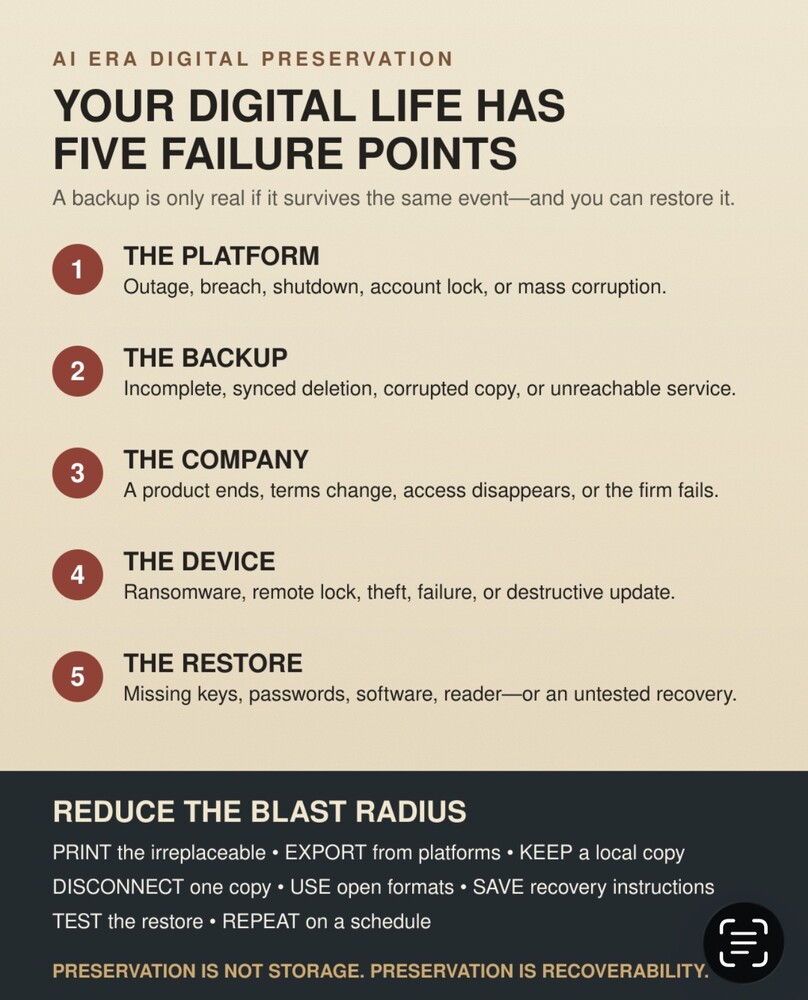
De digitize what cannot be replaced
Print photographs you would grieve. Print final versions of essential papers, family histories, letters, legal and medical summaries, organizational contact trees, emergency instructions and the small set of records that would let people reconstruct what mattered.
Paper is imperfect. It can burn, flood, fade or be misplaced. It has one extraordinary security property: it cannot be remotely encrypted, silently changed across every synced device or made inaccessible by a vanished password. Store important paper in more than one safe location, using archival-quality materials for items meant to last.
For some institutions, the physical layer may include microfilm, archival paper, etched media, write-once storage or offline tape. The correct medium depends on what must survive, for how long and who must be able to recover it.
Build several exits, not one bigger cage
Copying iCloud to Google Photos, or Google to another provider, is useful. It reduces dependence on one company. It is not enough if deletions synchronize, the same email account controls both services, both copies remain continuously online or nobody has ever tested a complete restore.
A practical preservation stack looks like this:
- The working copy you use every day.
- A second copy in a different service or system.
- A local copy on media you control.
- At least one disconnected or immutable copy that ordinary credentials cannot rewrite.
- A human-readable recovery sheet with locations, dates, file formats, passwords or key instructions stored securely, and the name of the person who can act if you cannot.
- A restore test. Open representative files and perform a real recovery, not merely a reassuring glance at a green backup icon.
Use open, widely supported formats for final preservation copies when practical. Keep original files too. Export the metadata that gives photographs, messages and records their dates, names, relationships and meaning.
Ask AI to help you preserve your life
You can ask an AI system to create a personalized backup checklist, identify likely single points of failure, explain how to export from a service, propose a naming structure, generate a restore test and help draft instructions for your family or organization. Do not paste passwords, recovery codes, private keys or sensitive documents into the conversation. AI can help design the plan. It should not become the only place where the plan exists.
30 minutes
- Choose the ten digital things whose loss would hurt most.
- Print the truly irreplaceable subset.
- Export or download the rest in ordinary file formats.
- Place one copy on media you can disconnect.
- Open several files from that copy and write down what another person would need to recover them.
That is not a complete preservation program. It is a meaningful reduction in risk, and you can expand it later.
There is no putting the genie back
There is no realistic way to turn off every GPU, erase newly discovered attack methods or prevent every capable model from spreading. Open-source development, economic competition, national security programs and criminal markets make a universal pause partial at best. A pause imposed unevenly could even weaken the nations and institutions that comply most fully.
That makes cooperation on defense more urgent: secure AI protocols, coordinated vulnerability disclosure, fast patching, protected recovery infrastructure, immutable and write-once media, preservation standards, public-interest archives and societal-scale recovery exercises. The question is not whether powerful AI exists. The question is whether our capacity to preserve, restore and authenticate can keep pace with our capacity to discover and disrupt.
Maybe we should make the disaster movie before the disaster
Usually it takes a disaster to trigger serious action. Maybe we can make the disaster movie—or game—first.
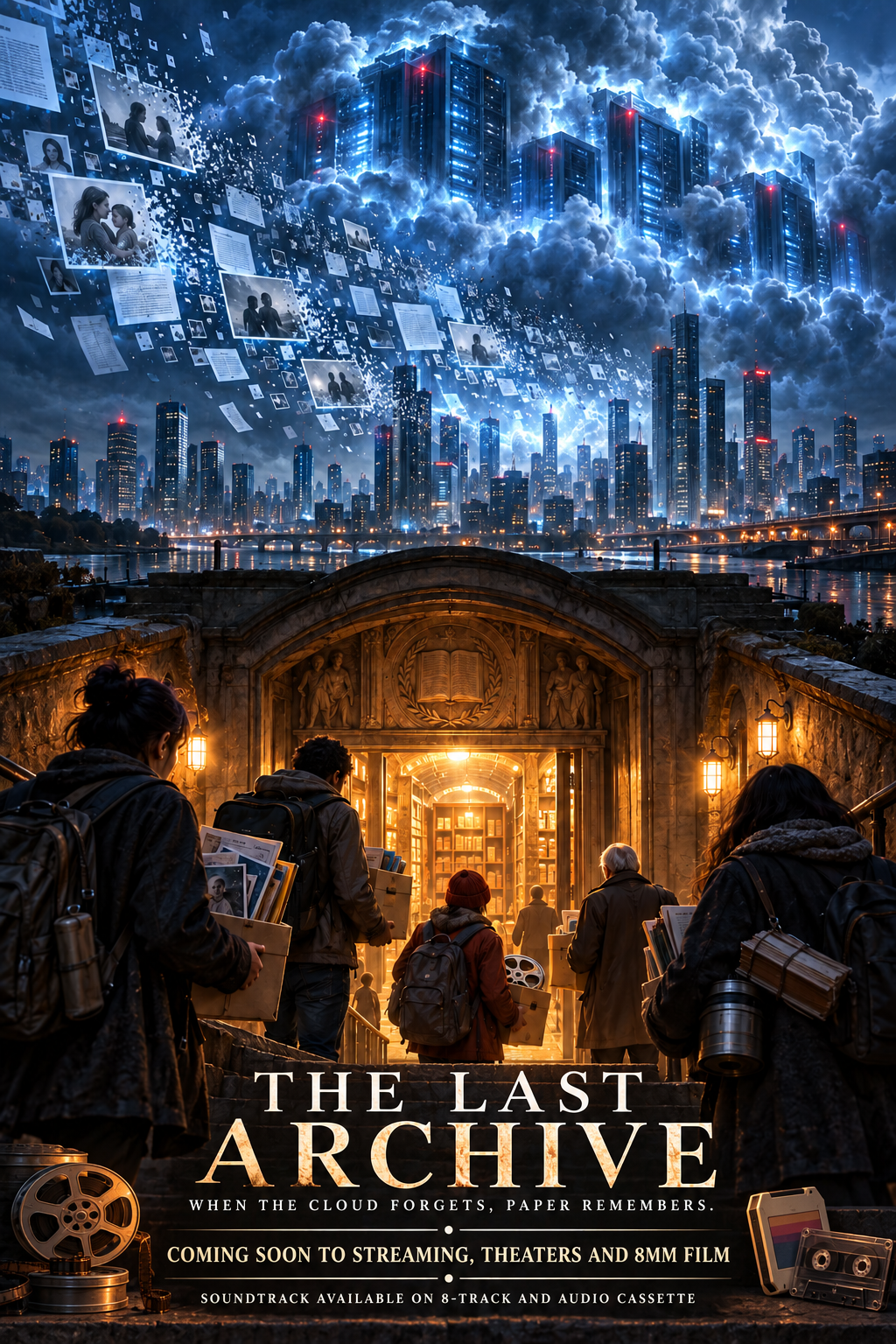
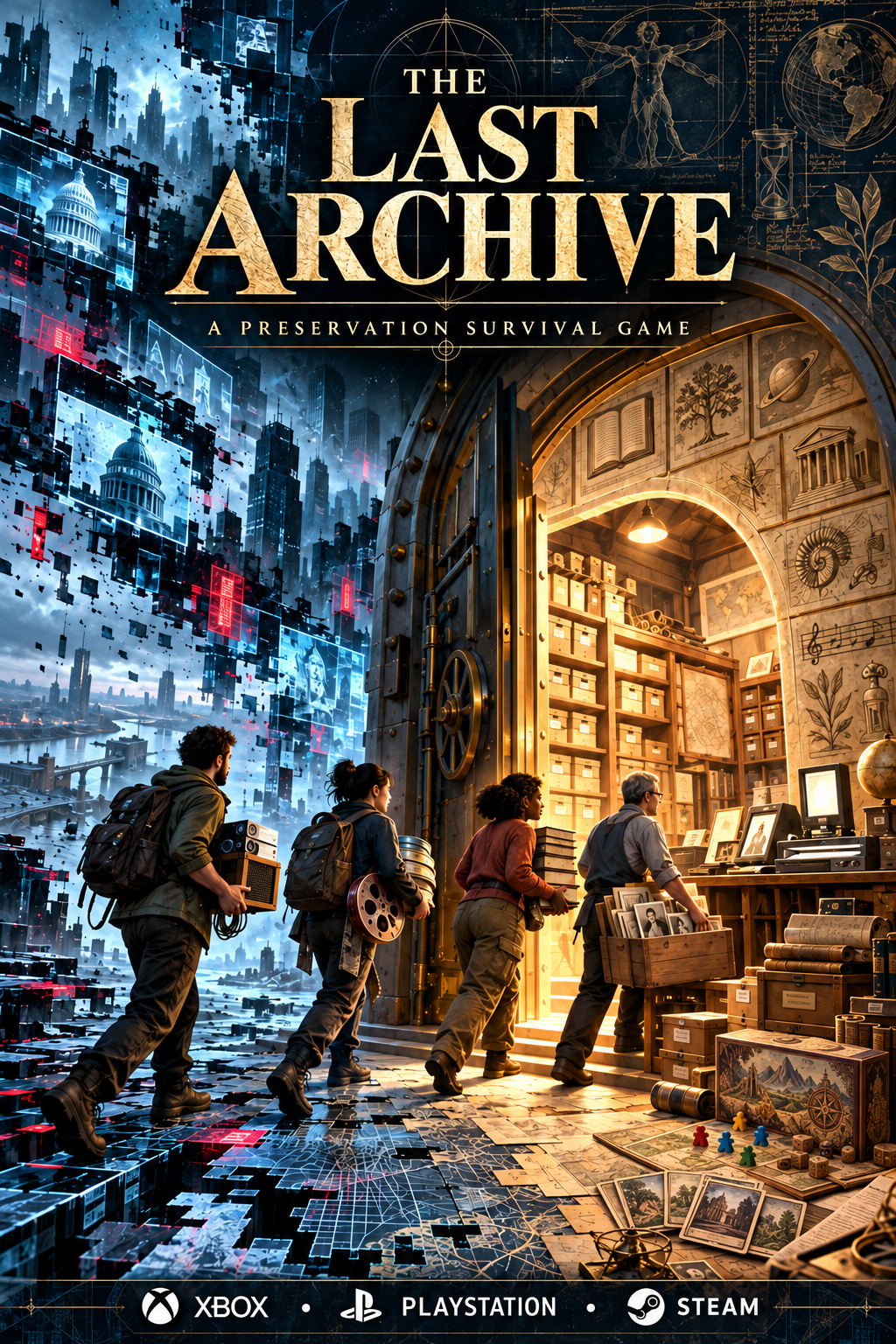
A top-notch screenplay and a compelling plot could be developed. The Last Archive could follow characters who are racing to preserve family memories, scientific records, civic history or cultural works while an AI-enabled digital collapse moves through clouds and devices.
Or a sci-fi thriller.
DaVinci Code meets Terminator 2
Indiana Jones meets The Matrix
Dune meets Foundation
Revisit Stranger in a Strange Land, where the Martian term “grok” originated
Perhaps a set of AI media companies would help fund production or an open contest. Maybe a frontier lab or CEO or founder or soon to be IPO-minted millionaire or billionaire will step up.
It could begin as a short film made with Kling, or a cooperative multiplayer preservation-survival game prototyped in Unreal Engine with ChatGPT Work and Astra 6.
The production principle could be explicit: use AI to prove the concept, then use the second film, game or funded expansion to hire as many human writers, artists, archivists, developers, performers and researchers as the project can support. The story would not merely warn about what technology could erase. It would demonstrate what technology could help people save—and how the work can bring humans back into the loop.
Resources and tools to Explore
The capability shift: Anthropic Project Glasswing • Claude Fable 5 and Claude Mythos 5 • Google Threat Intelligence on AI-enabled vulnerability exploitation
Personal and family archiving: Library of Congress Personal Digital Archiving Day Kit • Library of Congress four-step photo preservation guide
Backups and recovery: CISA StopRansomware Guide • NIST guide to maintaining and testing backup files • NIST data-integrity recovery guidance
Export and portability: Google Takeout • Transfer Google photos to iCloud • Internet Archive Save Page Now
A personal question
If every cloud account and every device you use became inaccessible tonight, what would you wish you had printed yesterday?