ARTICLE · TODD KELSEY
Inside the Math Toolbox: AI + Quantum
The way we learn math for AI and quantum has significant implications for education and our workforce. The options we have influence who feels inspired, who keeps going, and who builds something useful.
Often a person realizes the opportunities in quantum and AI: a new career, an application that could help people, a new discovery. But when they encounter the prerequisites, the knowledge that gets them in the door for a degree, the math and coding can look like a brick wall.
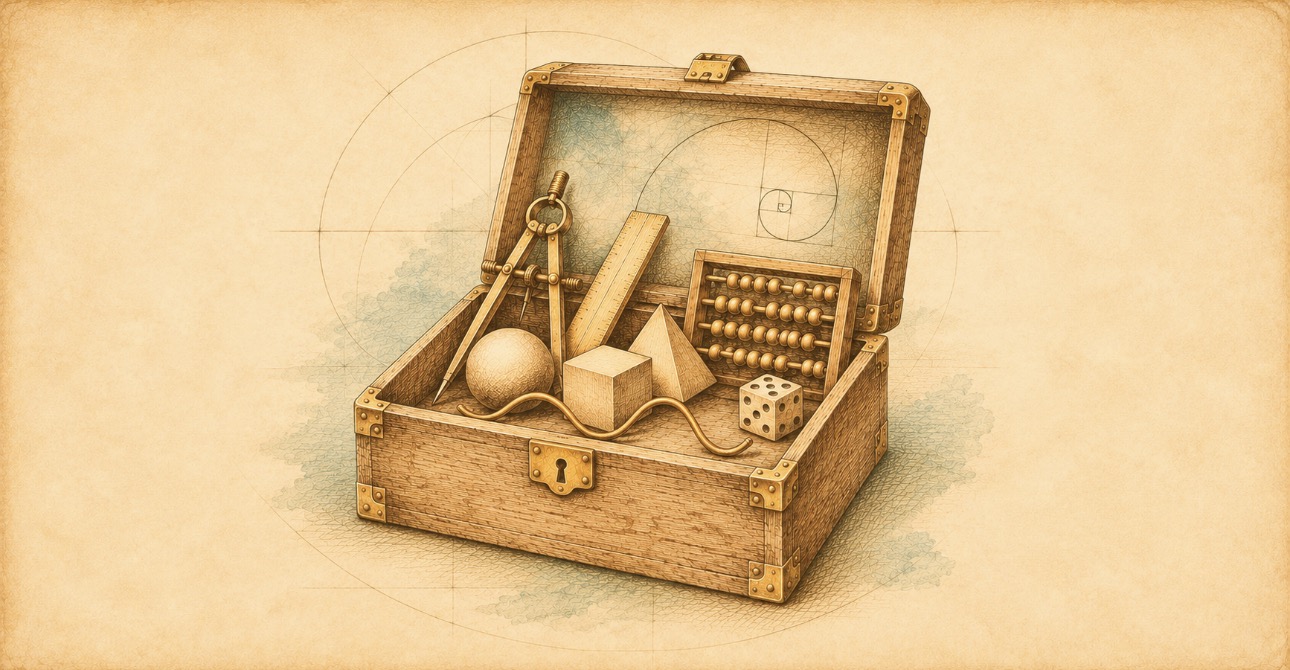
I would like more people to experience math as a toolbox—with useful things inside, and someone willing to help them open it.
For a variety of reasons, math for AI and quantum is often delivered with a one-size fits all approach. But not everyone will need the same tools or the same depth. For example, there is a difference between the math needed to use an algorithm and design an algorithm.
Three reasons to open the toolbox
An algorithm is a procedure for carrying out a task.
Math can help us:
- describe that task precisely,
- recognize assumptions,
- diagnose errors, and
- judge whether an answer means what someone clAIms.
When working with algorithms and software based on algorithms, there are roles people can move between, where the depth of math knowledge required can vary based on the task.
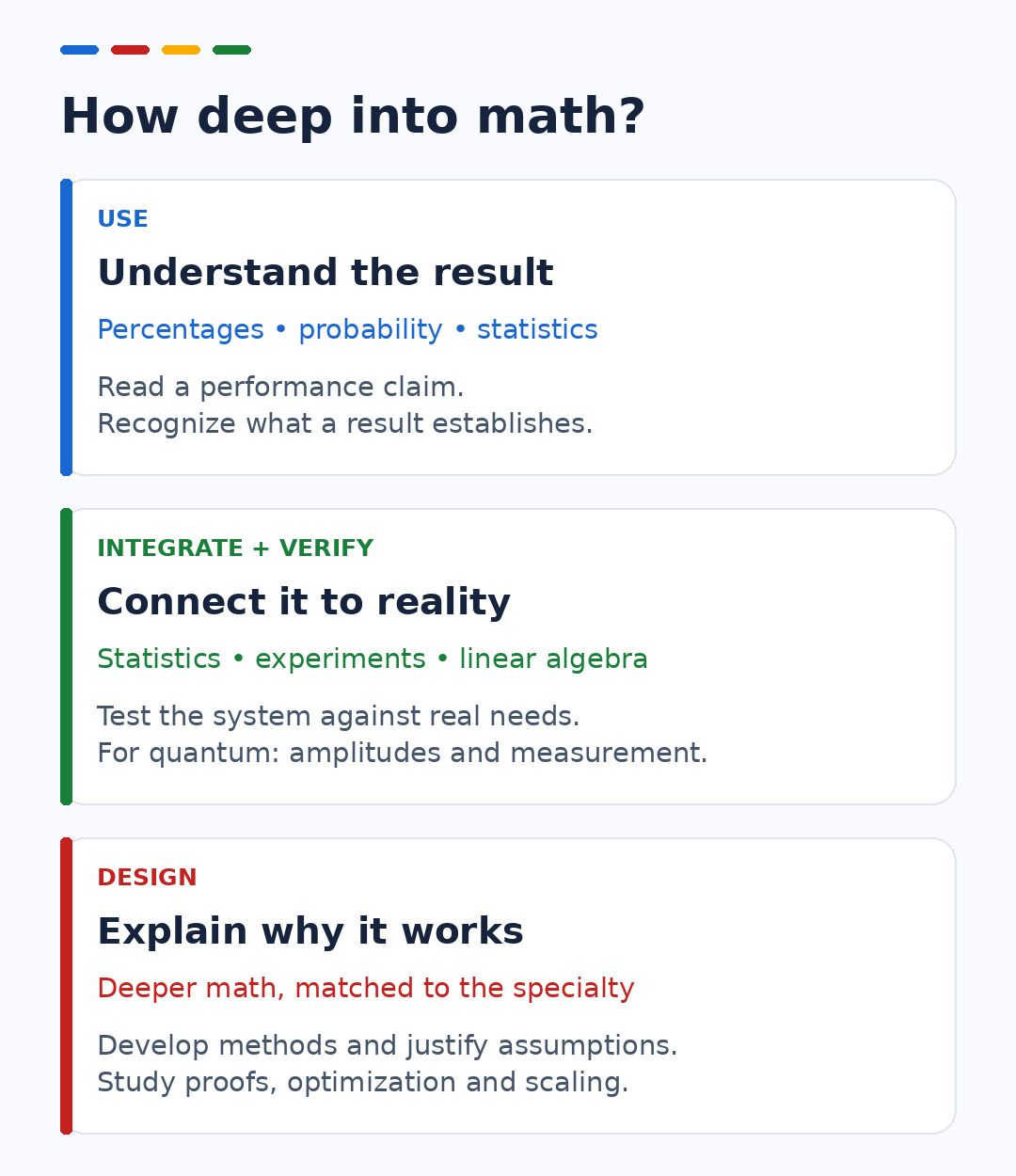
Role: The User
Using an algorithm
Using an algorithm, a platform, a software tool. Using AI-powered or quantum-powered programs.
Understanding math = understanding the results
Someone using an AI assistant to draft a letter can begin immediately. Someone choosing a prediction system needs enough quantitative understanding to interpret its performance. Percentages, probability, graphs, and basic statistics become useful tools. A quantum application user similarly needs to understand what was measured and what the result establishes.
Role: The Applier
Applying an algorithm
Applying an algorithm; applying AI or quantum at a business; integrating these technologies into a workflow; connecting the results to reality. Making it real.
These people may assemble systems and test whether they work. They need to translate a real problem into inputs, choose meaningful tests, compare alternatives, and explain uncertAInty.
Statistics and experimental design matter; linear algebra helps with many models. Quantum application work can add amplitudes, complex numbers, measurement, and the cost of getting a problem into and out of the computer.
Role: Algorithm designers
Designing an algorithm
These people learn how to design algorithms and explain how they work.
Designing new machine learning methods or quantum algorithms calls for deeper mathematical fluency. Depending on the specialty, that can include calculus, optimization, probability, linear algebra, proofs, and computational complexity—the study of how resource needs grow with problem size.
This is where someone must establish what a method can do, under which assumptions, and at what cost.
Here is a visual that gives a sense of the levels. They correspond roughly to levels of education that have evolved around them.
And here are two examples of learning maps, which you can explore with your own mind alone, or with the benefit of using an AI chatbot as a tutor:
Google’s Machine Learning Crash Course lists algebra, linear algebra, and statistics among its prerequisites; calculus is optional for the course.
IBM’s quantum foundations course recommends basic linear algebra, complex numbers, sets, and functions.
These are useful maps into particular subjects. A whole workforce needs multiple maps.
Companies like workera.AI have made significant advances in personalized assessment and mapping. (i.e., taking an inventory of your knowledge and pointing towards where you need to go)
More progress is needed.
The moment the math becomes useful
Consider an AI system that claims 96% accuracy at detecting spam. Sounds promising.
Now imagine a test containing 100 messages: 96 ordinary messages and four spam messages. A system that calls every message ordinary is 96% accurate—and catches no spam at all.
That small difference changes how you read the claim.
An AI agent can build the test and explain the result.
Understanding the math helps you check the explanation, recognize the same problem elsewhere, and decide what evidence you need next.
This is an example of math depth serving as a useful tool for an algorithm user.
Linear algebra offers another doorway.
A matrix can look like an intimidating grid of numbers. Watch it rotate or stretch an arrow, and the grid becomes a description of an action. 3Blue1Brown’s visual explanation makes that connection tangible. Suddenly, an unfamiliar object has something you can see it doing.
In quantum computing, a particularly revealing step is learning that amplitudes are different from probabilities. IBM’s introduction to quantum information describes states using complex-valued amplitudes. Their squared magnitudes give measurement probabilities. Their relative phases also matter: contributions can reinforce or cancel before measurement.
Learning that distinction gives you a way to understand interference and follow what a quantum algorithm is actually doing.
These are reachable discoveries you can make. We all need more aha moments. The great thing about an aha moment is it can give you a jolt of energy or inspiration to pursue more aha moments.
Light bulbs, early and later
Mathematician Steven Strogatz recalled a high-school pendulum experiment. As he plotted measurements, he recognized a pattern from algebra. His reaction: “this pendulum knows algebra!” A classroom subject had become a way to see the physical world.
Barbara Oakley describes a different entrance. In her first-person account, she writes: “I didn’t start studying remedial math until I left the Army at age 26.” She connected learning math with the practice that had helped her learn Russian, and eventually became an engineering professor.
Her story also gives practice its due. An insight can start the adventure; repeated attempts help make it something you can use.
Whether someone is 17, 37, or 67, I would like our educational invitations to leave room for that possibility: the next useful idea may change what you believe you can learn.
When the symbols become monsters
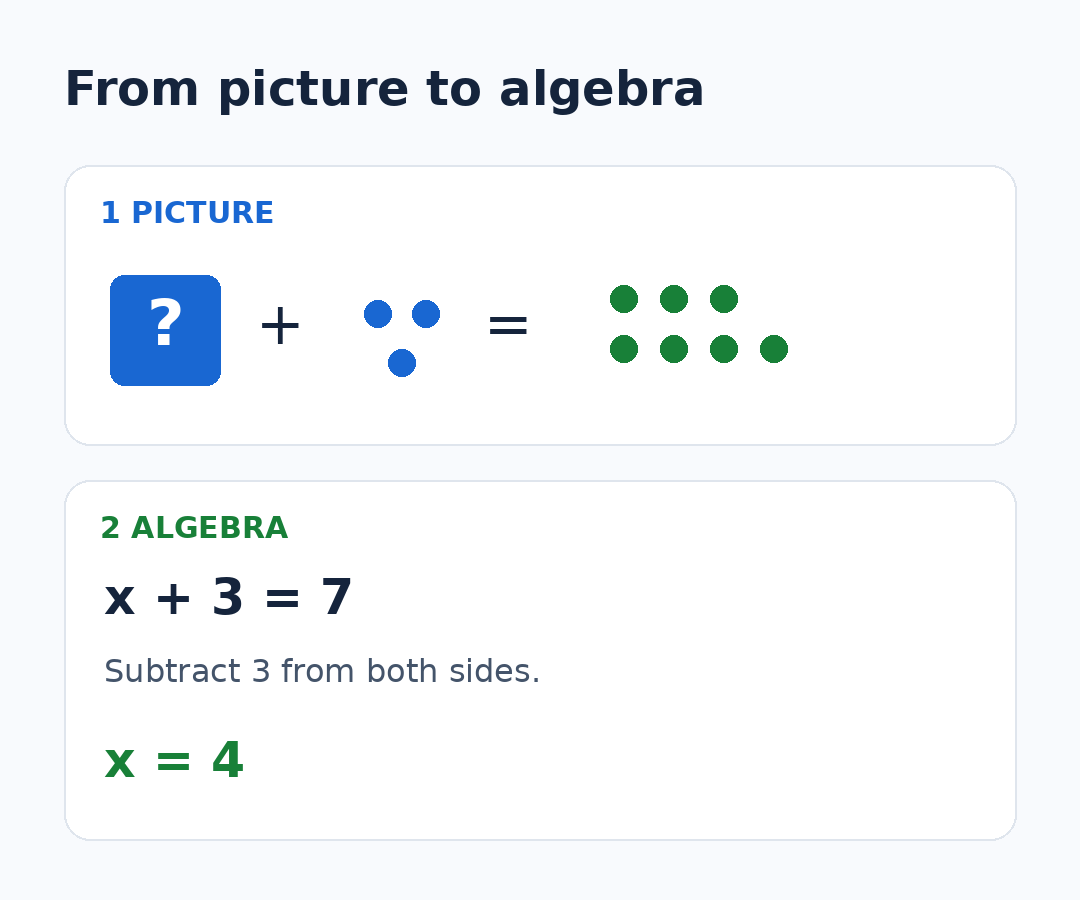
DragonBox Algebra offers a delightful change of scenery. Early puzzles use picture cards, including creatures, instead of immediately confronting the learner with conventional algebra. As the game progresses, drawings give way to numbers and variables. The player is learning to isolate an unknown.
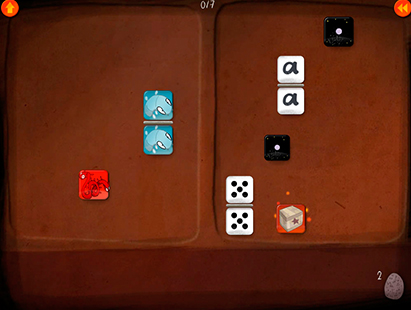
DragonBox Algebra 5+ gameplay screenshot from the official product page. Creature cards appear alongside emerging mathematical notation. Image © Kahoot DragonBox AS.
The University of Washington’s early summary of its 2013 Algebra Challenge reported a striking result: among participants who played for at least 1.5 hours, 92.9% reached the game’s mastery level. That measures achievement inside the adaptive game. It makes the next design task especially interesting: help learners connect those successful moves to equations on paper.
A later randomized classroom study found that seventh graders assigned to DragonBox performed better on an algebra knowledge assessment than students assigned to online problem sets with feedback after assignments. The intervention provided nine half-hour sessions. The researchers also highlighted the importance of connections between game actions and mathematical concepts.
The underlying possibility is exciting: a different representation can make an idea approachable. Then we can deliberately connect the picture, the symbol, the words, and the calculation..
Symbol swapping is not just for children. Neither are games. Adults can also benefit from playful ways to explore a difficult subject.
Warning: there is a horrific danger to be aware of when playing a play-tested, enjoyable, well-made game: the difficult subject may become an enjoyable subject. Beware!
Enjoyability is underrated, as if motivation was not important for learning. But even simple games can be enjoyable. For example, the image below reminds me of dominoes.
Hmmm. If you have stopped to read this warning, it might mean something. Be fairly forewarned that you may go to sleep tonight wondering if you could make a fun game. Where you play an unusual form of dominoes. Stranger things have happened.
Let the tools help you investigate
The resources are already substantial. NumPy can handle numerical arrays and calculations. SymPy can manipulate symbolic expressions and solve equations. IBM Quantum Composer provides a visual environment for exploring circuits and their predicted measurement probabilities.
An AI agent can help you figure out where to start, find the most helpful videos or visual aids, or make personal visual explanations.
With time, practice, and support, there are many routes to the mathematical knowledge a particular goal requires. Making those routes easier to find and follow seems like a worthwhile investment.
FOR SCI-FANS: try reading, listening to or watching the Foundation series by Isaac Asimov. It’s one of the most prophetic, popular science fiction series of all time. It also happens to have math towards the center of the plot - extremely useful math and a field called psychohistory that the future of the universe depends on in the story. Great fun.
Motivation belongs in the design
A syllabus tells us what someone is expected to learn. It tells us much less about what it will take for that person to stay engaged long enough to learn it.
Math anxiety deserves more attention than a passing reassurance. It can involve dread, avoidance, and memories of embarrassment. In a study of 46 third graders, researchers found that highly math-anxious children showed reduced anxiety after eight weeks of individual tutoring. SustAIned, supported encounters with math can change the experience of it.
The same lesson matters when designing opportunities for adults. A learner may be working two jobs, managing pAIn or fatigue, caring for family, or wondering whether another course will pay off. Time, money, energy, and confidence shape whether a resource is usable. A ten-minute exercise connected to a meaningful goal can be a better next step than an enormous list of prerequisites.
Workera describes adaptive assessments aligned with roles and goals. Its post-assessment guidance includes personalized recommendations and lessons tied to skill gaps. That illustrates one piece of a promising design: find where a person is, identify a useful next step, and adjust as they learn.
Other pieces include visual explanations, games, worked examples, Python notebooks, practice, and mentoring. Many pieces exist. Connecting them into affordable, coherent paths—and testing whether people can use what they learn—is work worth doing.
Children arrive as the newest learners in a very old human story. Millions of years of evolution sit behind the people now encountering AI and quantum. A teacher’s tone of voice, expression, patience, and willingness to stay with a puzzled student deserve a place in our designs. In-person mentoring gives those human signals room to work.
I would invest in tools for instructors as well as students: explanations they can adapt, ways to notice confusion earlier, shared hands-on lessons, and time to mentor. Teachers need conditions that make patient teaching possible.
Motivation is overlooked and underrated. Helping someone want to return tomorrow can be part of helping them become capable next year.
An invitation to begin
Choose one thing you would like to understand: an AI performance clAIm, a moving arrow, or a simple quantum circuit. Spend ten minutes with one example. Make a prediction, try it, and explain one thing you noticed.
Ask for help from a human or an AI bot or both. Ask a friend or family member to explore it with you. Ask AI for practical relevant math knowledge, and how math is used in AI and quantum.
That is a beginning someone can build on.
If we want more children to grow into AI and quantum professionals, scientists, and educators—and more adults to find a new direction—we should invest in the people and conditions that make those beginnings possible.
There is an adventure inside the toolbox. Let’s help more people open it.