ARTICLE · TODD KELSEY
What if the Most Important Part of an Orbital Data Center Was a Piece of Glass?
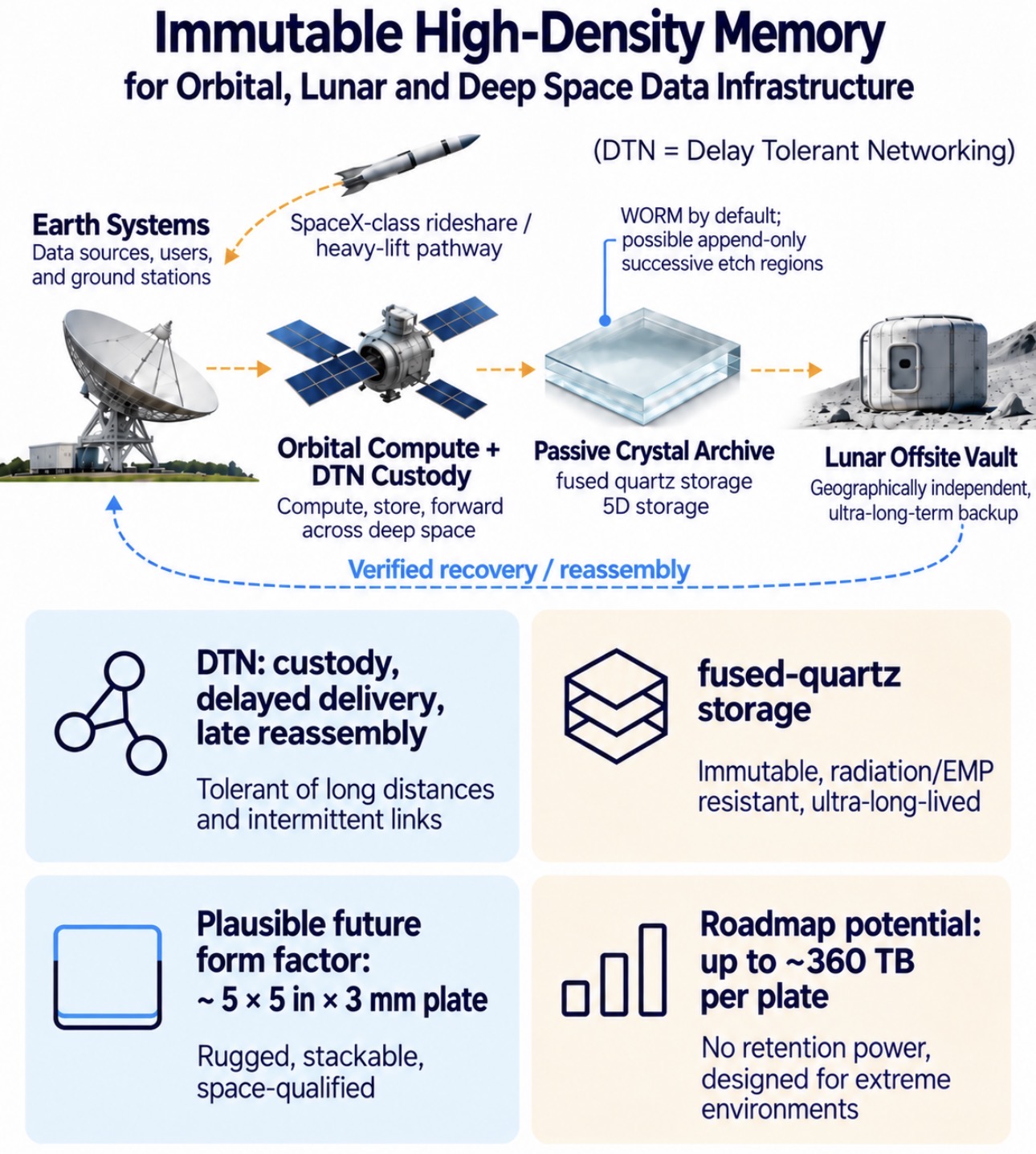
Immutable high-density memory for orbital, lunar, and deep-space data infrastructure
It might be the most important part: not because it does the most computation, but because it may be the part that survives everything else.
Glass is resilient, and emerging 5D fused-quartz storage combines high information density with extraordinary projected longevity. SPhotonix cites voxel lifetimes far beyond a million years at room temperature; the underlying University of Southampton work reports thermal stability up to 1,000°C and an extrapolated lifetime comparable to the age of the universe even at 190°C. The point is not that quartz is indestructible. It is that catastrophic failure or damage that destroys other components may still leave the quartz as a recoverable source of data — like a flight recorder that can survive a plane crash, but for spaceflight.
Orbital data centers are moving from speculative architecture toward engineering and commercial reality. Most emerging work begins, reasonably, with active compute, networking, conventional persistent storage, power, thermal management, radiation tolerance, and communications. A complementary question is whether part of the storage stack should be physically passive: extremely dense, immutable media that can sit outside the terrestrial failure domain without drawing power simply to retain data.
For me, this line of thought grows out of earlier Digital Vellum and Trusted AI Interoperability Protocol (TAI-IP) work. The idea is not to replace live storage. It is to add a trusted archival layer beneath it. Delay Tolerant Networking (DTN) custody nodes can move, verify, and reassemble data; active orbital systems can compute on it; a passive medium can preserve selected snapshots, manifests, keys, cultural records, or recovery sets for very long horizons.
The architecture could be something like this:
Earth systems → orbital compute and DTN custody → immutable archival media → geographically separated replicas and eventually extraterrestrial.
Current landscape
Lonestar is explicitly developing off-Earth data resilience. The company says it demonstrated lunar-edge data operations and, in 2026, signed a NASA Space Act Agreement focused on lunar data storage, resilient off-world compute infrastructure, and next-generation space communications. Its stated vision includes independently recoverable, disaster-resilient data capabilities beyond Earth.
Starcloud is building orbital GPU and data infrastructure and has described Starcloud-2 as a platform that will include persistent storage and critical-data backup independent of terrestrial infrastructure. That architecture is centered on active compute, but it also creates a natural place for an additional passive archival tier behind the working storage layer.
TakeMe2Space is developing orbital compute as a service and has described plans for orbital cold storage for critical financial and defense data. That makes it a particularly direct example of a project where dense passive media could complement active storage and reduce how much archival capacity must remain powered.
Google is also beginning to test AI-compute hardware in space through Project Suncatcher. Taken together, these efforts suggest that several threads are converging: DTN-style custody and delayed delivery, orbital edge compute, sovereign and disaster-resilient off-world storage, and increasingly routine launch access.
The storage question is no longer only whether data can be kept in space. It is what kind of media should occupy the coldest, longest-lived layer of the stack.
Emerging high-density immutable media
SPhotonix is a useful baseline. Its 5D Memory Crystal approach uses femtosecond-laser writing to create nanoscale structures inside fused quartz. The company describes the medium as physically encoded, power-free for retention, resistant to heat, humidity, electromagnetic pulse, and harsh environments.
A plausible future form factor is a roughly 5 × 5 inch, 3 mm fused-quartz plate. SPhotonix currently reports several terabytes per disc and describes an ultimate target of about 360 TB for a larger plate- or disc-class medium. That 360 TB figure is a technology target, not present shipping density.
Even a fraction of that target is interesting in space because density is not merely a storage metric. It is a launch metric.
The more verified archival information that can be carried per kilogram and per cubic centimeter, the easier it becomes to replicate critical datasets across physically independent locations.
WORM — and perhaps append-only WMRM
The default model is WORM: write once, read many.
There may also be an interesting middle ground between WORM and ordinary rewritable storage. Instead of rewriting previously stored data, a system could reserve unused voxel regions or layers and add successive immutable etchings:
Snapshot 0 → Δ1 → Δ2 → Δ3
At the material level, the old state remains untouched. At the device level, the archive grows over time.
That would behave like an append-only write-many/read-many system constructed from WORM physics. It could be unusually useful for custody logs, provenance, signed manifests, cryptographic key transitions, model checkpoints, policy state, and state-at-action records—cases where silently rewriting history is undesirable.
A flight implementation would need much more than a bare piece of quartz. It would need a protective enclosure, mechanical qualification, radiation testing of the complete module, indexing and error-correction design, and either a local reader or a defined return/readout path.
The near-term concept is therefore a rugged “crystal cartridge,” not an unsupported plate floating inside a satellite.
How this could help current projects
For Lonestar, a passive archival tier could sit beneath lunar or orbital active storage. Selected recovery images, sovereign archives, cryptographic manifests, or disaster-recovery snapshots could be mirrored onto media that requires no retention power and is physically distinct from ordinary SSD failure modes.
For Starcloud, quartz need not compete with working storage optimized for GPU clusters. It could become a deep-cold tier for model checkpoints, provenance records, high-value datasets, keys, and recovery images—especially material that should survive a compute-node failure or a long period offline.
For TakeMe2Space, a compact crystal cartridge could be a clean hosted-payload experiment: test density, thermal and radiation behavior, custody transfer, readout, and the economics of “archive in orbit, compute only when needed.”
For DTN custody networking, an immutable copy could become the final local custody object after verified receipt or late reassembly. Hashes, receipts, and BPv7-related integrity metadata could travel with the payload and be committed to a physically append-only archive.
For Digital Vellum, the medium could become a durable Layer 0 beneath formats, metadata, emulators, and preservation software. The long-horizon problem is not merely whether bits survive, but whether enough context survives for a future reader to recover meaning.
For TAI-IP and related trusted-AI architectures, high-density WORM media could provide an offline trust anchor for root manifests, identity records, large keys, policy state, and recovery material. Successive immutable etchings could preserve a physical history of trust-state transitions without silently replacing older states.
Shoot for the Moon
High density changes the launch equation. The relevant metric is not simply terabytes per plate. It is verified archival terabytes per launched kilogram and per unit of protected payload volume.
If mature 5D quartz approaches hundreds of terabytes in a compact plate, one small protected cartridge could contain multiple independent recovery sets. Several cartridges could then be distributed across separate orbital nodes.
SpaceX makes this strategically interesting because its rideshare program has normalized frequent secondary-payload access to orbit, while Falcon missions can accommodate multiple payloads and SpaceX accepts inquiries for higher-energy destinations including translunar injection.
A first experiment does not need to be a lunar data center. It could be a hosted or secondary-payload crystal vault in low Earth orbit. A later version could place an immutable recovery copy in cislunar space or on the lunar surface once the medium, enclosure, encoding, and readout architecture are flight-qualified.
The lunar version is a longer-horizon idea: Earth retains active copies; orbital nodes hold compute, DTN custody, and fast persistent storage; a lunar vault holds selected immutable recovery sets.
The Moon is useful here not because it is dramatic, but because it is far away.
A failure, attack, policy dispute, terrestrial disaster, or simply a century of technological churn would have to cross multiple physically different failure domains before the archive disappeared.
That architectural diversity is the strongest reason to explore the idea. Conventional orbital data centers remain computers and inherit many computer failure modes. A passive quartz archive introduces a fundamentally different retention mechanism, and high density can make that diversity cheaper to launch.
A practical first experiment
The first useful study can be much smaller than a lunar data center:
Can a compact fused-quartz WORM cartridge serve as the immutable cold tier of a DTN-enabled orbital storage architecture?
The study could specify realistic current density rather than ultimate density; target payload size; crystal mass and enclosure; environmental qualification; encoding and ECC; custody metadata; readout path; append-only etching geometry; and a ground/orbit/lunar replication model.
Even a “not yet” answer would be valuable because it would identify the exact density, read/write, mass, qualification, and cost thresholds that make the architecture attractive.
We may be entering an era in which preserving important data means thinking beyond a single cloud, a single continent, and eventually a single planet.
The coldest layer of that architecture might turn out to be surprisingly simple: a small piece of glass.
References
Burleigh, S., Fall, K., & Birrane, E., III. (2022). Bundle Protocol Version 7 (RFC 9171). RFC Editor.
https://www.rfc-editor.org/rfc/rfc9171.html
Coughlin, T., Kelsey, T., & Cerf, V. G. (2025). Communicating with the future. IEEE Computer, 58(9), 118–122.
https://doi.org/10.1109/MC.2025.3579276
Lonestar Data Holdings. (2026, May 11). Lonestar signs NASA Space Act Agreement.
https://lonestar.space/press-releases/lonestar-signs-nasa-space-act-agreement-
Reuters. (2026, September 24). Google plans first test of AI chips in space under Project Suncatcher.
Reuters. (2026, September 28). India’s TakeMe2Space to launch orbital computing satellite on SpaceX rocket.
SPhotonix. (n.d.). 5D Memory Crystal FAQs.
https://sphotonix.com/5d-memory-crystal-faq/
University of Southampton. (2016, February 18). Eternal 5D data storage could record the history of humankind.
https://www.southampton.ac.uk/news/2016/02/5d-data-storage-update.page
SpaceX. (n.d.). Smallsat Rideshare Program.
https://new.spacex.com/rideshare
Starcloud. (n.d.). Starcloud-2: In-space GPU cluster and cloud computing satellite.