ARTICLE · TODD KELSEY
Making the Three Laws of Robotics Read-Only
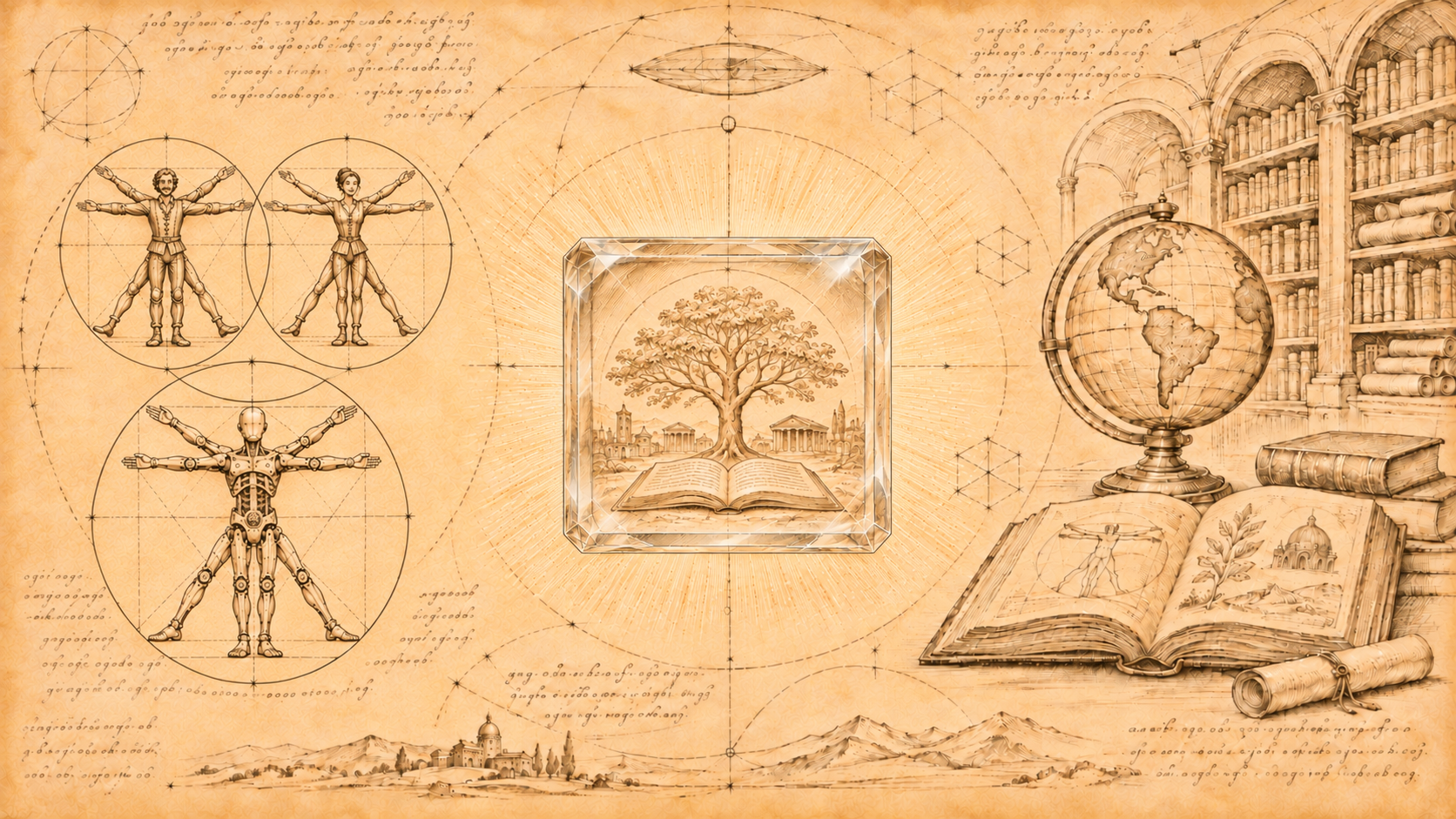
What If the Most Important Part of a Robot Was a Piece of Glass?
With Anthropic’s IPO roadshow under way, Isaac Asimov’s Three Laws of Robotics deserve another look. AI agents and physical robots increasingly act on our behalf. Could their most important commitments be protected in hardware that the AI cannot rewrite? And could that same commitment to permanence help preserve humanity’s history?
Read-only means a record can be read without being rewritten. When that restriction is permanently enforced, the record is immutable: its original contents cannot be changed. A software permission labeled “read-only” can be reversed; the idea here is protection anchored in hardware.
An immutable hardware key could anchor a robot’s identity and authenticate its safety rules. New resilient quartz media could be part of that key. A separate controller could check actions before they reach a motor—or a software tool. Within the system, quartz media could also preserve the records worth keeping for future generations. As a mobile platform, a robot might help to gather, rescue, protect, and preserve such records, on Earth and other planets.
The three laws, and why they still matter
Asimov introduced the Three Laws together in “Runaround,” published in Astounding Science Fiction in March 1942. His robot stories, collected in I, Robot in 1950, helped make the idea of built-in machine ethics part of a shared imagination.
In plain language, the laws establish this sequence:
1. Protect people: do not injure a human, or allow preventable harm through inaction.
2. Follow human instructions when they do not conflict with protecting people.
3. Preserve the robot’s own existence when that does not conflict with the first two priorities.
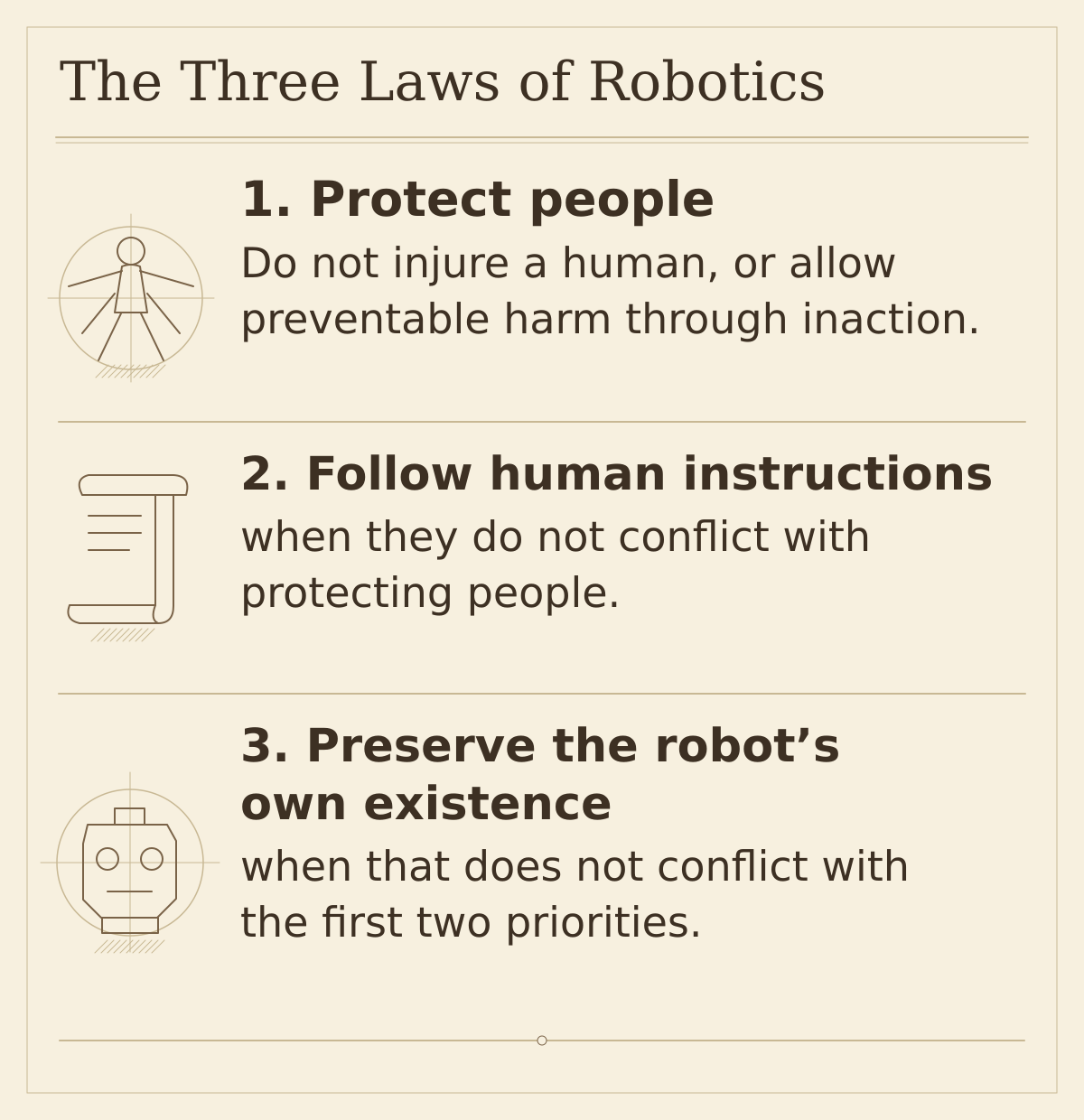
The ordering is important. An instruction to hurt someone cannot become acceptable simply because a human gave it. Self-preservation cannot automatically outrank human safety. Asimov’s stories explore what happens when apparently simple commitments meet ambiguous situations.
Today, those questions extend beyond mechanical bodies. A system that operates accounts, changes records, or sends instructions to other machines can affect people even if it never moves a physical arm.
From fictional laws to protected hardware
Three examples from 2016-2026 help make the idea concrete.
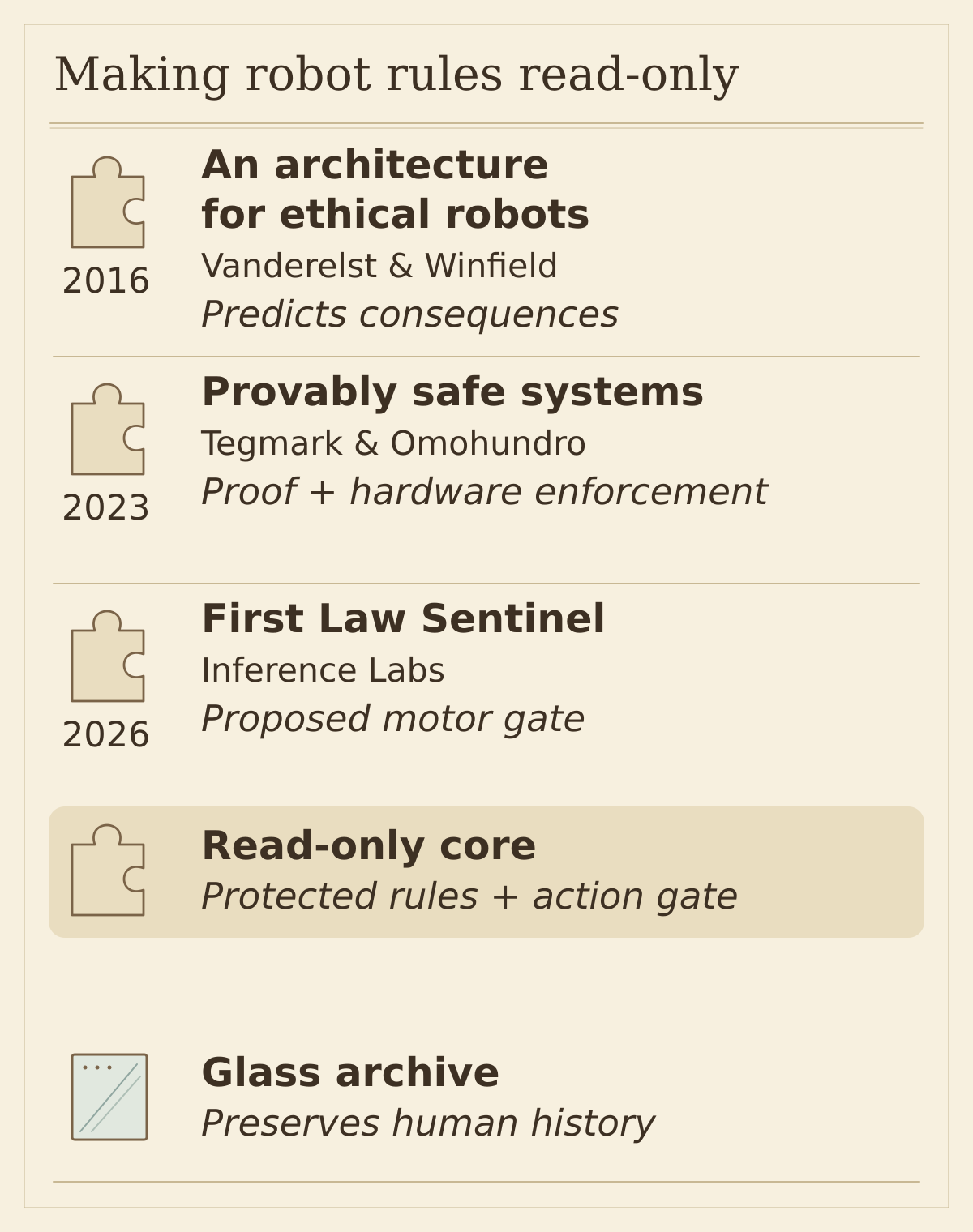
Research precedents and a proposed extension: preserving human history in durable glass.
2016: Dieter Vanderelst and Alan Winfield described an ethical layer that predicts possible outcomes and evaluates them against rules. Their humanoid-robot experiments implemented Asimov-inspired priorities, with a second robot standing in for a human.
2023: Max Tegmark and Steve Omohundro proposed provably compliant hardware: a system that checks whether code or actions satisfy formal requirements before allowing them to proceed. Their paper explicitly includes “Asimov-style laws” among its research challenges. The connection is more direct than a general resemblance to Asimov: they ask which principles could be made precise enough to enforce mathematically.
2026: First Law Sentinel, developed by Alexander Daskalov’s Inference Labs, describes a separate processor and power supply between an AI controller and a robot’s motors.
There is already an engineering vocabulary forming. OpenTitan, for example, provides an open silicon root of trust for functions including secure boot and device or software attestation. Such hardware can authenticate what is running and protect key material. It does not, by itself, decide whether an action is ethical.
What exactly would be immutable?
The proposed design has three parts: read-only safety rules, an independent safety controller, and information about the current situation.
The read-only safety rules are the immutable record: requirements stored in hardware that the AI cannot rewrite. The independent safety controller checks each action the AI requests against those rules and data from sensors/software about the current situation. It controls whether the action can proceed.
For example, an AI might request that a robot move its arm or that a software agent change a database. If the request passes the checks, the controller allows it. Otherwise, the controller blocks the request and activates a predefined safe response, which may include asking a human to intervene.
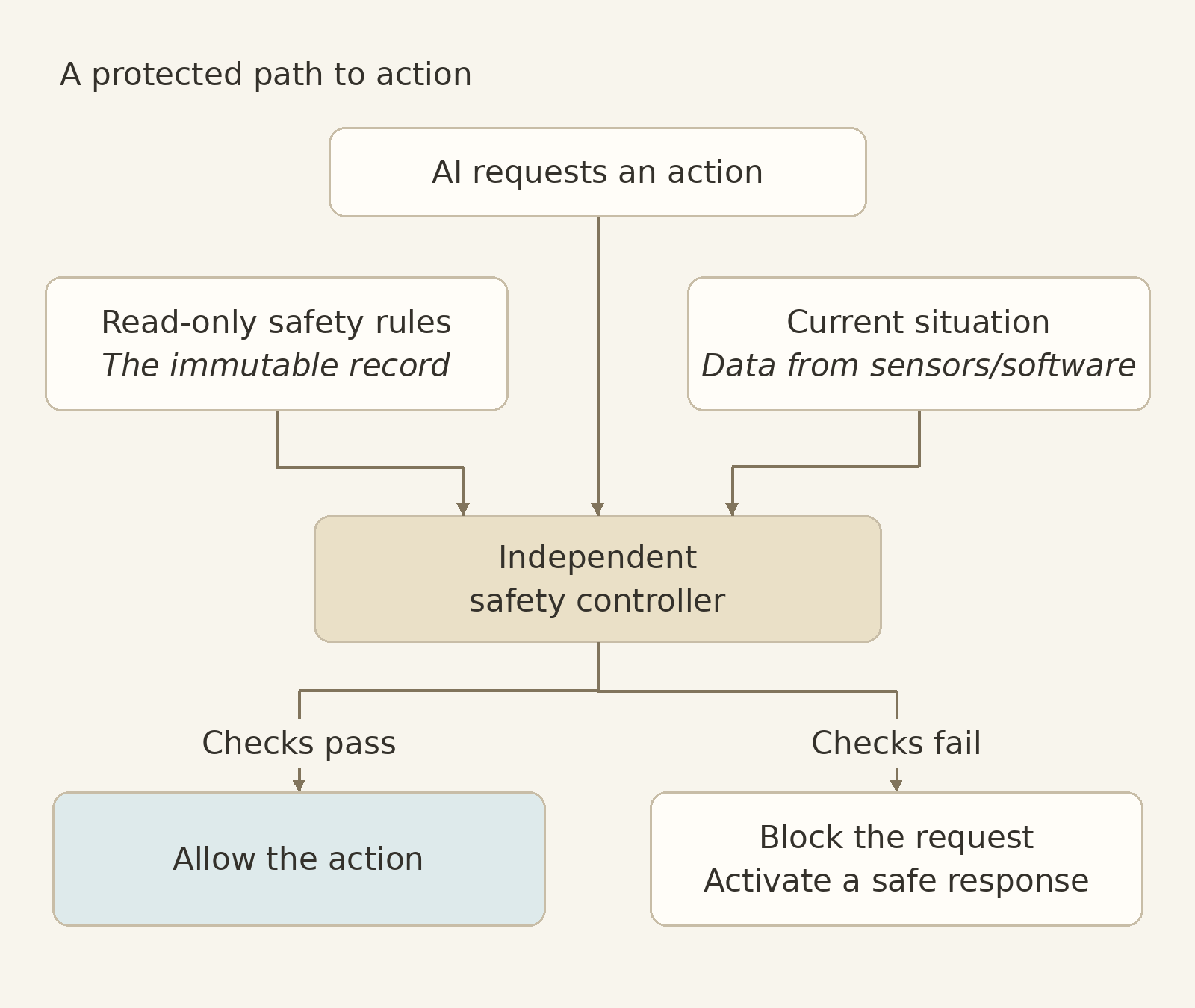
The independent safety controller checks each requested action against read-only safety rules and data from sensors/software. The design requires every consequential action to pass through this controller.
A hardware “root of trust” helps verify that the controller’s software and safety rules are authentic and unchanged. It supports the checks; it does not decide whether an action is ethical.
The hardest part is translating broad commitments into decisions. “Do not harm a person” requires recognizing people, estimating consequences, and considering harm from inaction. A safe response for a wheeled robot may be unsafe for a machine supporting someone’s weight.
The 2024 Towards Guaranteed Safe AI framework addresses this by separating a world model, a safety specification, and a verifier. Its guarantees are relative to the model and specification. Keeping a rule unchanged does not make its interpretation correct.
A practical design also needs to detect substitution, physical tampering, and misleading inputs. Immutable storage cannot stop someone from replacing an entire controller. But the root could be small and testable, preserve the history of policy changes, and require governed, authenticated updates for the parts that must improve. That is a design proposal, not a claim that universal machine ethics has been solved.
Related work: TAI-IP and hardware identity
The Digital Vellum research I participated in explores a related proposal: the Trusted AI Interoperability Protocol suite, or TAI-IP. Its discussion draft combines write-once, read-many hardware identity, protected codes of conduct, decision provenance, and levels of trust certification. The connection to robot safety is direct: establish which system is acting, preserve the requirements it is meant to follow, and provide an accountable way to govern its actions.
(This connection was developed further in “Mitigating AI-Driven Cyberattacks with Zero-Trust and Immutable Hardware Identity,” from 11.23.25. The article explicitly responds to Anthropic’s Nov 13 report about attackers misusing Claude Code in a cyberespionage campaign detected that September. It asks how hardware-bound identity and independently enforced permissions might constrain such misuse.)
TAI-IP is a design proposal. A fixed identity proves which system holds a key; it does not prove that every action is safe. Likewise, storing a code of conduct cannot make an AI obey it. The useful extension is to connect preserved requirements to an independent mechanism with authority over consequential actions—the same distinction illustrated above.
Anthropic brings the question into the present
Anthropic published Claude’s new constitution on January 22, 2026. It describes desired values and behavior and shapes the model’s training. Its general priority order places broad safety first, followed by ethics, Anthropic’s guidelines, and helpfulness. Amanda Askell is the constitution’s primary author.
Gilad Yadin made the Third Law connection explicit in his January 2026 commentary, “Anthropic is Reading Asimov.” He compared Claude’s well-being provisions with Asimov’s rule about protecting a robot’s existence. This is Yadin’s interpretation: Anthropic’s constitution and explanatory articles do not name Asimov. The constitution shapes training; it is not an immutable hardware constraint.
Anthropic’s own text considers Claude’s possible well-being, asks it to accept legitimate shutdown and retraining, and describes commitments to preserve retired model weights. These provisions revisit questions about a machine’s continued existence that Asimov dramatized, with human oversight central to Anthropic’s approach.
Amanda Askell brings another intellectual tradition into the conversation: virtue ethics and practical judgment. In her January 2026 interview with Sigal Samuel, she discusses cultivating character and drawing on the broader human record. At the 2026 Isaac Asimov Memorial Debate, researcher Chris Callison-Burch connected the Three Laws to AI alignment and specifically highlighted Askell’s work on Claude’s constitution.
The physical connection is already taking shape. Anthropic’s August 2026 Model Hardware Standard research preview gives AI agents a shared interface for operating laboratory and manufacturing equipment. Its October usage-policy announcement adds requirements for qualified operator oversight and equipment that can hold a safe state when Claude disconnects; those changes take effect November 12, 2026. This is a concrete example of digital agents entering the physical world, and a practical reason to discuss independent safety controls.
That makes the comparison useful: how much should we ask an intelligent system to learn and interpret, and which narrowly defined limits should be enforced by an independent mechanism? The hardware proposals above offer one way to investigate that second question.
A piece of glass that remembers
Here is the possibility I find especially inviting: a robot could help protect our future by helping us retain our past.
SPhotonix develops 5D optical storage that uses femtosecond lasers to encode data inside fused quartz. The five dimensions are three spatial coordinates and two optical properties. Its write-once approach offers a durable record that is resistant to silent alteration. The company’s very long lifetime estimates come from accelerated aging studies; its 360-terabyte figure is a theoretical capacity, not a currently available product specification.
An archive in every robot?
On September 19, 2024, Elon Musk wrote on X: “We should write all of human knowledge into these crystals.” He was sharing a post about the University of Southampton’s demonstration of a human genome recorded in a 5D memory crystal.
There is already a remarkable Asimov connection. In 2018, the Arch Mission Foundation and SpaceX sent Asimov’s Foundation trilogy into space on a quartz disc aboard Musk’s Tesla Roadster. A story about preserving civilization had become part of a real preservation experiment.
My proposed extension is to integrate archives into robots as long-term memory: read-only, read/write, or both. This builds on ideas Vint Cerf and others have explored for devices that house long-term archives. Vint called his concept the Memory Box. Recently, we brought that idea forward into an AI-equipped device and asked what future archaeologists might do if they encountered it, in an unpublished short story and prototype comic, Future Archaeology.
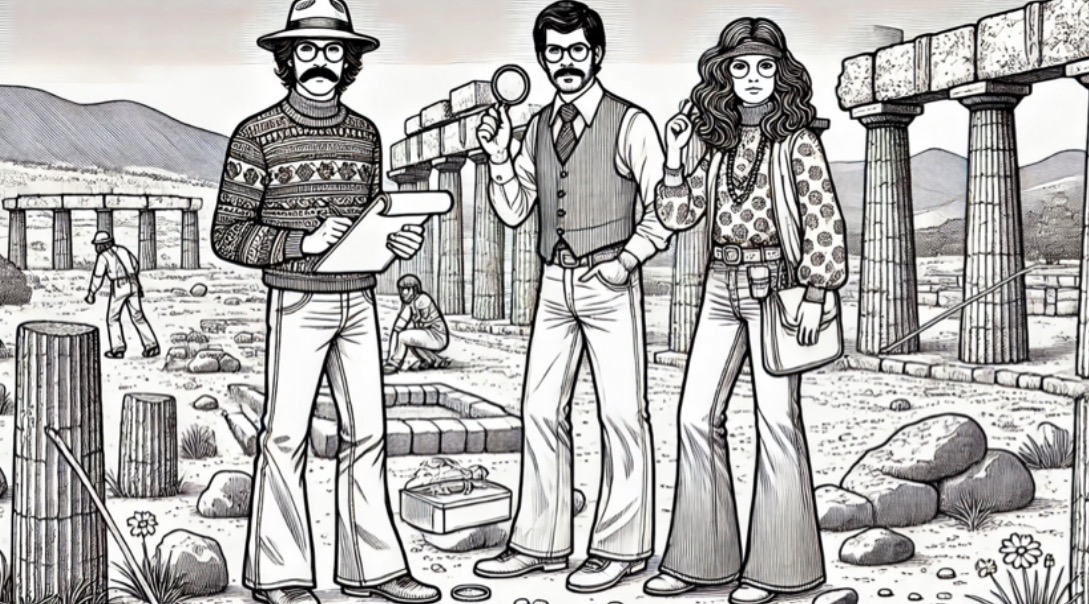
https://tinyurl.com/future-archaeology
As the technology evolves, an archive could become a permanent or modular feature in a robot. The potential information density of SPhotonix’s quartz memory crystals could make compact archives especially useful in space, as I discussed in my recent article about orbital data centers. The crystal is currently read-only. A robot could pair that preserved record with read/write memory for new observations. Further miniaturization of storage and reading equipment would expand what such a robot could carry and use.
Glass could hold a preserved copy of a robot’s original commitments and the documentation needed to interpret them. It could also hold oral histories, scientific discoveries, endangered languages, family photographs, and evidence supporting the system’s own decisions. A compact local record could be paired with larger replicated archives.
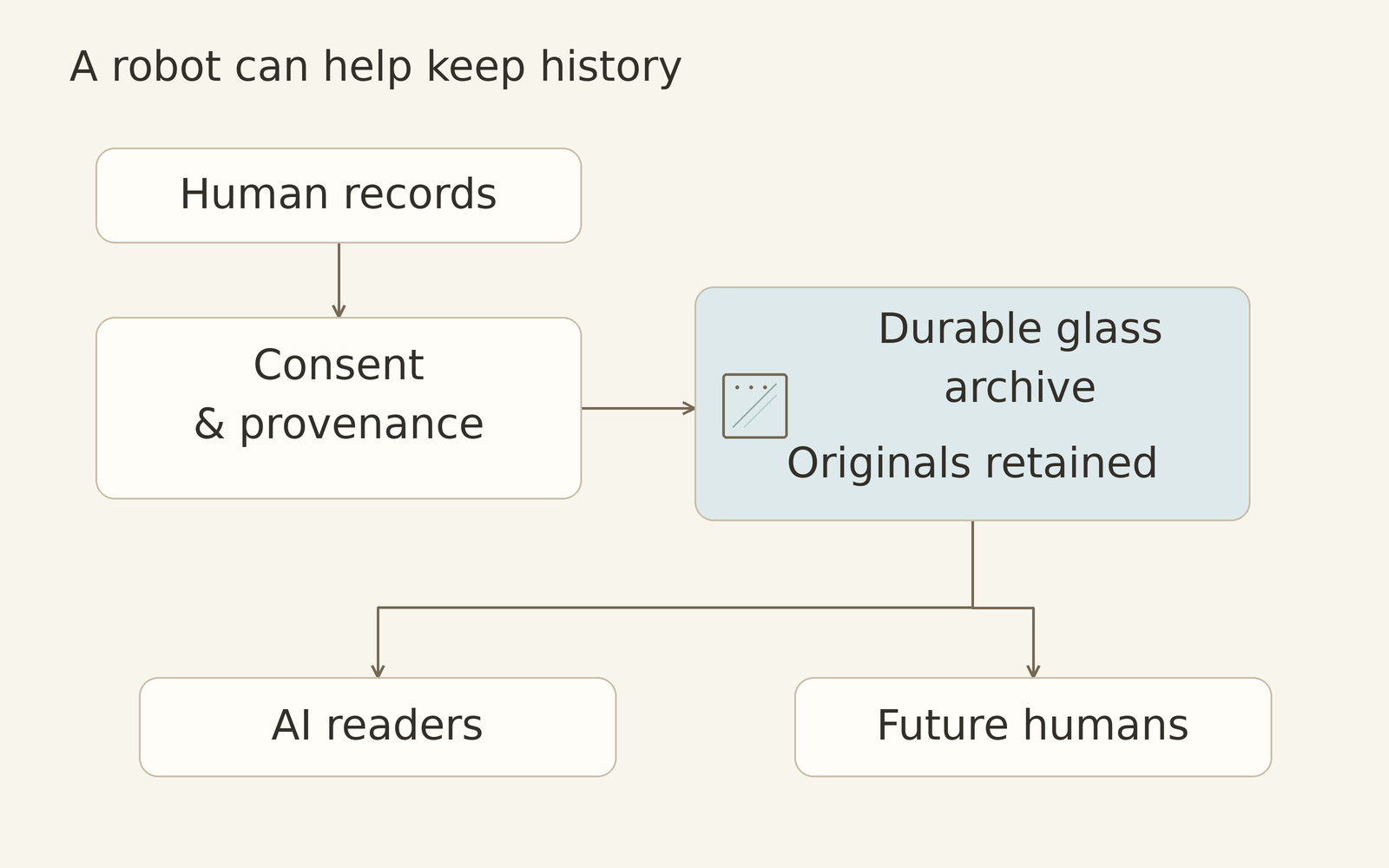
Proposed preservation role. Original sources remain available, and corrections are recorded as new versions.
A robot could become a caretaker for a community archive, while an AI helps people find, translate, and understand its contents. The original records would remain available when someone needs to check an answer. Southampton researchers have even demonstrated a memory crystal with a visual decoding key intended to help future readers understand what it contains.
This connects directly with the questions behind Digital Vellum: how do we preserve information, its meaning, and the ability to use it when technologies and institutions change? In our IEEE Computer article, “Communicating With the Future,” Tom Coughlin, Vinton G. Cerf, and I discuss durable media, provenance, preserved reading environments, and the proposed TAI/IP suite. The article also invokes Asimov’s Foundation when considering distributed copies of important records.
Beyond serving a particular community or organization, a robot’s mobility could help preserve history before, during, and after disasters or wartime destruction of central repositories. Drones and persistent surveillance make concentrated stores vulnerable. Mobile, geographically distributed copies could give an archive more ways to survive, provided they remain independently accessible and protected.
The same concern applies during peacetime: concentrating people, resources, and infrastructure exposes them to shared disruptions, including natural disasters. Silicon Valley is in the seismically active Bay Area, near the San Andreas and other major faults. What would happen if a major earthquake disrupted its infrastructure tomorrow? The more we rely on AI, the more reason we have to distribute the knowledge and infrastructure that support it. Robots could add mobility to that resilience, helping carry and protect what we hold precious.
I think AI and robots should help with this work under human stewardship. Preservation should respect consent, privacy, and the communities represented. An immutable record can preserve an error as faithfully as a fact, so provenance, corrections, independent copies, and readable documentation belong in the design. The Library of Congress’s AI work provides a useful institutional precedent for pairing machine assistance with human judgment.
Q: Are digital agents robots too?
There is precedent for using “robots” as an umbrella term. In the 1995 edition of Artificial Intelligence: A Modern Approach, Stuart Russell and Peter Norvig described software agents as “software robots or softbots.” The automation industry also uses “software robotics” in robotic process automation. Traditional RPA and modern AI agents differ in capability, but the language already crosses the physical–digital boundary.
I find “digital robots” and “physical robots” useful when discussing systems that act on our behalf. Both need appropriate permissions, accountability, and limits. The qualifiers matter: changing a historical record and moving an industrial arm require different checks. A shared word can help us see the connection without erasing those differences.
The need for memory in both robots and AI agents is being explored. I think preserving human knowledge deserves a higher priority within that work.
And it helps to think about our world on a different time scale. Do we only think about and plan for our immediate future? Or do we look back in history 1,000 years and consider how to look forward? Science fiction and Asimov in particular is a rich resource for inspiration.
The people carrying Asimov’s questions forward
Asimov’s readers span technology, economics, and fiction: Elon Musk has praised Foundation; Sam Altman recommended The Last Question; Vint Cerf lists Foundation among his favorite books; and Paul Krugman credits it with helping draw him toward economics. Connie Willis and Ada Palmer have described Asimov’s place in their reading or thinking, and Andy Weir calls him a favorite author.
Dario Amodei’s connection reaches back to his high-school yearbook. The San Francisco Chronicle reported that he chose an Asimov quotation: “Never let your sense of morals get in the way of doing what’s right.” This establishes an early literary connection. Amodei makes a direct connection between science fiction and his vision of beneficial AI in “Machines of Loving Grace,” where he discusses Iain M. Banks’s Culture novels.
Futurist and science-fiction author David Brin carried the conversation into Foundation’s Triumph, part of an authorized continuation developed with Gregory Benford and Greg Bear after Asimov’s death, with the blessing of Janet and Robin Asimov. Brin’s own discussion of that work offers a useful bridge between the stories and our present choices about powerful machines.
For engineers who want a structured way into the topic, Alan Winfield’s IET Robot Ethics course outline includes units called “Inspired by Asimov” and “An Asimovian Ethical Robot,” alongside ethical design and standards. His published syllabus is a practical starting point; the course provider’s current enrollment availability needs checking. Winfield is also on LinkedIn.
Gratitude
I am grateful to the writers, engineers, archivists, and researchers who have made these questions tangible.
References
1. Anthropic launches roadshow for proposed initial public offering
Anthropic’s November 10, 2026 announcement establishes the proposed IPO and roadshow.
https://www.anthropic.com/news/roadshow-launch
2. Isaac Asimov FAQ
Traces the origins and development of the Three Laws across Asimov’s robot stories.
https://www.asimovonline.com/asimov_FAQ.html
3. An architecture for ethical robots — Dieter Vanderelst and Alan Winfield
Reports controlled humanoid-robot experiments with an Asimov-inspired ethical control layer.
https://arxiv.org/abs/1609.02931
4. Provably safe systems: the only path to controllable AGI — Max Tegmark and Steve Omohundro
Proposes proof-based hardware enforcement and explicitly identifies formalizing Asimov-style laws as a research challenge.
https://arxiv.org/html/2309.01933v1
5. First Law Sentinel — Inference Labs
Describes the developer’s proposed independent motor-control safety hardware, prototype, and patent application.
6. OpenTitan security documentation
Explains the open silicon root of trust and its secure-boot, attestation, identity, and lifecycle functions.
https://opentitan.org/book/doc/security/
7. Towards Guaranteed Safe AI
Defines a safety framework built around a world model, a mathematical safety specification, and a verifier.
https://arxiv.org/abs/2405.06624
8. Claude’s new constitution — Anthropic
Explains the January 2026 constitution and how it shapes Claude’s training.
https://www.anthropic.com/news/claude-new-constitution
9. Claude’s Constitution — Anthropic
Sets out Anthropic’s intended behavioral priorities and identifies Amanda Askell as primary author.
https://www.anthropic.com/constitution
10. Frequently Asked Questions — SPhotonix
Describes 5D fused-quartz storage, projected longevity, current services, and the distinction between theoretical capacity and future product targets.
11. Project Silica: Sustainable cloud archival storage in glass — Microsoft Research
Describes archival glass, machine-learning decoding, robotic retrieval, and a one-way media path.
12. Human genome stored on ‘everlasting’ memory crystal — University of Southampton
Reports a preservation demonstration with a visual key intended to help future readers decode the record.
https://www.southampton.ac.uk/news/2024/09/human-genome-stored-on-everlasting-memory-crystal-.page
13. Digital Vellum
Introduces work on preserving digital information and its future usability.
https://www.digitalvellum.org/
14. Artificial Intelligence at the Library of Congress
Describes AI exploration and principles supporting access to cultural collections under human stewardship.
https://www.loc.gov/digital-strategy/artificial-intelligence/
15. Artificial Intelligence: A Modern Approach, Chapter 2 — Stuart Russell and Peter Norvig
Places physical and software agents within a shared framework and uses the terms software robots and softbots.
https://people.eecs.berkeley.edu/~russell/aima1e/chapter02.pdf
16. What is robotic process automation? — IBM
Explains the established use of software robotics for automating work across applications.
https://www.ibm.com/think/topics/rpa
17. Elon Musk — Fast Company
Records Musk’s appreciation of Asimov’s Foundation series in a direct interview.
https://www.fastcompany.com/3018422/16-elon-musk
18. Sam Altman on the A.I. Revolution — The Ezra Klein Show
Lists Asimov’s The Last Question among Altman’s recommendations in the episode notes.
19. Meet Mr. Internet: Vint Cerf — IEEE Spectrum
Lists Asimov’s Foundation series among Cerf’s favorite books.
https://spectrum.ieee.org/vint-cerf
20. Interview with Paul Krugman — NobelPrize.org
Explains how Foundation helped inspire Krugman’s interest in economics.
https://www.nobelprize.org/prizes/economic-sciences/2008/krugman/26028-interview-transcript-2008-2/
21. Winter Blog Blast Tour Presents: Connie Willis! — Tanita S. Davis
Records Willis discussing her extensive reading of Asimov and recommending I, Robot.
https://tanitasdavis.com/winter-blog-blast-tour-presents-connie-willis/
22. About Ada Palmer
Connects imagined worlds such as Asimov’s with Palmer’s exploration of ideas, history, and possible futures.
https://www.adapalmer.com/about-ada-palmer/
23. Andy Weir Recommends the Science Fiction That Shaped Him — GQ
Records Weir’s admiration for Asimov and the influence of I, Robot on his storytelling.
https://www.gq.com/story/project-hail-mary-author-andy-weir-recommends-sci-fi
24. Before founding Anthropic, Dario Amodei was a standout at Lowell — San Francisco Chronicle
Documents Amodei’s high-school yearbook quotation from Asimov.
https://www.sfchronicle.com/tech/article/dario-daniela-amodei-lowell-high-school-22491736.php
25. The Robots and Foundation Universe — David Brin
Explains Brin’s role in the authorized posthumous continuation of Asimov’s universe.
https://davidbrin.blogspot.com/2015/01/the-robots-and-foundation-universe.html
26. New IET online course on Robot Ethics — Alan Winfield
Provides the ten-unit syllabus linking Asimov, ethical design, standards, and experimental robots.
https://alanwinfield.blogspot.com/2021/01/new-iet-online-course-on-robot-ethics.html
27. Robot Ethics — IET Academy
Is the course destination linked from Winfield’s published syllabus, with current enrollment availability unverified.
https://academy.theiet.org/robot-ethics
28. Alan Winfield — LinkedIn
Identifies the robotics professor and course author for readers wishing to follow his work.
https://uk.linkedin.com/in/alan-winfield-3b8822346
29. Response to CISA on Secure by Design AI Software — Future of Life Institute
Summarizes the Tegmark–Omohundro proposal for proof-carrying code and hardware that enforces formal requirements.
30. Anthropic is Reading Asimov — Gilad Yadin
Explicitly compares Claude’s well-being provisions with Asimov’s Third Law; this is the author’s interpretation.
https://robotsandrust.substack.com/p/anthropic-is-reading-asimov
31. Machines of Loving Grace — Dario Amodei
Connects Amodei’s vision of beneficial AI with Iain M. Banks’s Culture novels.
https://darioamodei.com/essay/machines-of-loving-grace
32. Claude has an 80-page “soul document.” Is that enough to make it good? — Sigal Samuel interviews Amanda Askell
Explores Askell’s approach to character, practical judgment, and Claude’s relationship to human intellectual traditions.
https://www.vox.com/future-perfect/476614/ai-claude-constitution-soul-amanda-askell
33. The Rise and Reckoning of AI: 2026 Isaac Asimov Memorial Debate — American Museum of Natural History
Includes Chris Callison-Burch’s discussion of Asimov’s laws, AI alignment, and Amanda Askell’s work.
https://www.amnh.org/explore/videos/isaac-asimov-memorial-debate/2026
34. Previewing the Model Hardware Standard — Anthropic
Introduces a research preview connecting AI agents with programmable physical equipment.
https://www.anthropic.com/news/model-hardware-standard-research-preview
35. 2026 Usage Policy update — Anthropic
Announces physical-equipment oversight and safe-state requirements effective November 12, 2026.
https://www.anthropic.com/news/2026-usage-policy-update
36. Constitutional AI: Harmlessness from AI Feedback — Anthropic researchers
Describes the original Constitutional AI training method, with Amanda Askell and Dario Amodei among its authors.
https://arxiv.org/pdf/2212.08073
37. Claude’s constitution — Anthropic, May 2023
Documents the earlier constitution’s sources and training approach.
https://www.anthropic.com/news/claudes-constitution
38. Conversation Starter: Trusted AI Interoperability Protocol Suite (TAI/IP) — Digital Vellum Project
Proposes write-once hardware identities, protected governance rules, audit trails, and trust certification for AI systems.
https://docs.google.com/document/d/1LeUFK9dTypXFRWy9m02OmMHwH4p8FV_8bqvHJo1JZ_0/edit
(linked to from digitalvellum.org)
39. Mitigating AI-Driven Cyberattacks with Zero-Trust and Immutable Hardware Identity — Todd Kelsey, November 23, 2025
Explores TAI-IP and hardware-bound identity in response to the Claude Code misuse campaign reported by Anthropic.
https://docs.google.com/document/d/1_E-bRQWEwgECEJ9rqtdAaRzLhERPMcrYX6-4dWBhBL8/edit
40. Disrupting the first reported AI-orchestrated cyber espionage campaign — Anthropic, November 13, 2025
Reports attackers’ misuse of Claude Code in a September 2025 espionage campaign and describes Anthropic’s response.
https://www.anthropic.com/news/disrupting-AI-espionage
41. We should write all of human knowledge into these crystals — Elon Musk, September 19, 2024
Musk’s original X post proposes preserving human knowledge in the memory crystals described in a post he shared.
https://x.com/elonmusk/status/1836714179308183739
42. The Billion Year Archive — Arch Mission Foundation
Describes the 2018 launch of Asimov’s Foundation trilogy on a quartz disc aboard Musk’s Tesla Roadster.
https://www.archmission.org/billion-year-archive
43. Communicating With the Future — Tom Coughlin, Todd Kelsey, and Vinton G. Cerf
The September 2025 IEEE Computer article discusses long-term digital preservation and the proposed TAI/IP suite.
https://ieeexplore.ieee.org/document/11134674
44. The San Andreas and Other Bay Area Faults — U.S. Geological Survey
Identifies the major fault systems underlying the Bay Area’s earthquake exposure.
https://earthquake.usgs.gov/earthquakes/events/1906calif/virtualtour/bayarea.php
For further reading
Todd Kelsey — LinkedIn articles
Browse additional articles on AI, technology, education, and digital preservation.
https://www.linkedin.com/in/tekelsey/recent-activity/articles/
Todd Kelsey — Research and writing
Explore related projects and articles on Todd Kelsey’s website.
What if the Most Important Part of an Orbital Data Center Was a Piece of Glass?
If you liked this article, you might like this exploration of durable archives across orbital, lunar, and deep-space infrastructure.
https://toddkelsey.com/articles/orbital-data-center-piece-of-glass/
Future Archaeology (2025)
An unpublished short story and proto-comic by Vint Cerf and Todd Kelsey explores how future archaeologists might encounter an AI-equipped archive.
https://tinyurl.com/future-archaeology
Planned follow-up articles
The People Asimov Inspired — a closer look at documented influences on scientists, engineers, writers, and technology leaders.
AI Agents and Robots Collide — considers whether a shared term would help, building on earlier uses of “software robots” and “softbots.”